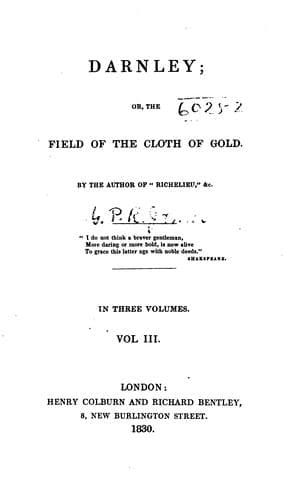
Darnley; or, The Field of the Cloth of Gold — John Shaqi
Darnley; or, The Field of the Cloth of GoldJames, G. P. R. (George Payne Rainsford)
History
Darnley; or, The Field of the Cloth of Gold
James, G. P. R. (George Payne Rainsford)
Great Britain -- History -- Henry VIII, 1509-1547 -- Fiction; Henry VIII, King of England, 1491-1547 -- Fiction
In many circumstances there was still a great degree of similarity
between them: both were deeply versed in classical literature, and
were endowed with every elegant attainment; and both possessed that
wild and vivid imagination which taught them to combine in one strange
and heterogeneous system the pure doctrines of Christianity, the
theories of the Pagan philosophers, and the strange, mysterious
notions of the dark sciences they pursued. Amongst many fancies
derived from the Greeks, it seems certain that both Sir Cesar and
Cornelius Agrippa received, as an undoubted fact, the Pythagorean
doctrine of the transmission of the souls through the various human
bodies for a long period of existence: the spirit retaining, more or
less, in different men, the recollection of events which had occurred
to them at other periods of being.
One striking difference, however, existed between these two celebrated
men. Cornelius Agrippa was all mildness, gentleness, and suavity;
while Sir Cesar, irritated by the memory of much sorrow, was wild,
vehement, and impetuous; ever striving to do good, it is true, but
hasty and impatient under contradiction. The same sort of mental
excitement hurried him on to move from land to land and place to
place, without seeming ever to pause for any length of time; and as he
stood not upon the ceremony of introduction, but made himself known to
whomsoever the fancy of the moment might lead him, he was celebrated
in almost every part of the world.
So much as we have said seemed necessary, in order to give our readers
some insight into the character of the extraordinary man whose history
is strongly interwoven with the web of the present narrative, and to
prevent its being supposed that he was an imaginary being devised for
the nonce; but we shall now proceed with him in his proper person.
"Let us reason," said Sir Cesar, breaking form abruptly, after he had
ridden on with the young knight some way in silence; "let us reason of
nature and philosophy; of things that are, and of things that may be;
for I would fain expel from my brain a crowd of sad thoughts and dark
imaginings, that haunt the caverns of memory."
"I should prove but a slow reasoner," replied the young knight, "when
compared with one whose mind, if report speak truth, has long explored
the deepest paths of science, and discovered the full wealth of
nature."
Public-domain text, read in full here on John Shaqi.
Reviews
Reviews
No reviews yet
Be the first to share your thoughts on this work.
Join the Discussion
Join the discussion
Sign in to leave a comment or review.
Sign InorCreate an account