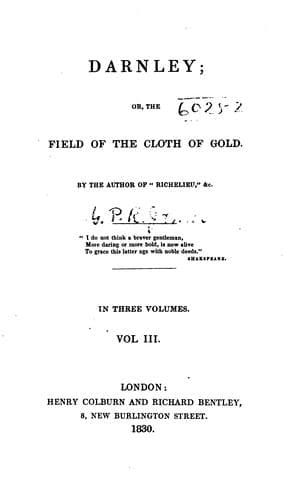
Darnley; or, The Field of the Cloth of GoldJames, G. P. R. (George Payne Rainsford)
History
Darnley; or, The Field of the Cloth of Gold
James, G. P. R. (George Payne Rainsford)
Great Britain -- History -- Henry VIII, 1509-1547 -- Fiction; Henry VIII, King of England, 1491-1547 -- Fiction
"Nay, nay, my friend," answered the old man; "something I have
studied, it is true; but nature's full wealth who shall ever discover?
Look through the boundless universe, and you shall find that were the
life of man extended a thousand fold, and all his senses refined to
the most exquisite perfection, and had his mind infinite faculty to
comprehend, yet the portion he could truly know would be to the great
whole as one grain of sand to the vast foundation of the sea. As it
is, man not only contemplates but few of nature's works, but also only
sees a little part of each. Thus, when he speaks of life, he means but
that which inspires animals, and never dreams that everything has
life; and yet it is so. Is it not reasonable to suppose that
everything that moves feels? and we cannot but conclude that
everything that feels has life. The Indian tree that raises its
branches when any living creature approaches must feel, must have
sensation; the loadstone that flies to its fellow must know, must
perceive that that fellow is near. Motion is life; and if viewed near,
everything would be found to have motion, to have life, to have
sensation."
Sir Osborne smiled. "Then do you suppose," demanded he, "that all
vegetables and plants feel?"
"Nay, more, much more!" answered the old man. "I doubt not that
everything in nature feels in its degree, from the rude stone that the
mason cuts, to man, the most sensitive of substantial beings."
"It is a bold doctrine," said the young knight, who, willing to gain
what insight he could into his companion's character, pressed him for
a still further exposition of his opinions, though at the same time he
himself felt not a little carried away by the energy of manner and
rich modulation of tone with which the old man communicated his
singular ideas. "It is a bold doctrine, and would seem to animate the
whole of nature. Could it be proved, the world would acquire a glow of
life, and activity of existence, where it now appears cold and
silent."
"The whole of nature _is_ animated," replied Sir Cesar. "Life combined
with matter is but a thousandth part of life existent. The world teems
with spirits: the very air is thick with them. They dance in the
sunshine, they ride upon the beams of the stars, they float about in
the melodies of music, they nestle in the cups of the flowers; and I
am forced to believe that never a flower fades, or a beam passes away,
without some being mourning the brief date of loveliness on earth.
Doubt not, for this is true; and though no one can prove that matter
is sensitive, yet it _can_ be _proved_ that such spirits do exist, and
that they may be compelled to clothe themselves with a visible form.
It can be proved, I say, and I have proved it."
"I have heard the same reported of you," replied Sir Osborne, "when
you, with the renowned Cornelius Agrippa, called up a spirit to
ascertain what would be the issue of the battle of Ravenna. Was it not
so?"
Public-domain text, read in full here on John Shaqi.
Reviews
Reviews
No reviews yet
Be the first to share your thoughts on this work.
Join the Discussion
Join the discussion
Sign in to leave a comment or review.
Sign InorCreate an account