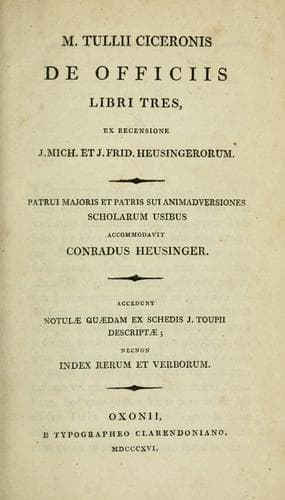
TRANSCRIBER'S NOTE:
Italic text has been marked with _underscores_. Inconsistencies in
hyphenation have not been corrected, punctuation has been silently
corrected. A list of other corrections to the text can be found at the
end of the document. In the book the Latin text is printed on the left
page, and the English translation on the right. Here, the text is split
by sections starting with a roman numeral, and the Latin text is
followed by its English translation. The section numbers that appeared in
the margin are placed between *asterisks*. Sidenotes are placed
between #hashtags# and are placed either above the paragraph they refer
to or inline. Numbers printed in superscript are preceded by a ^.
[Illustration: M. TULLIUS CICERO.
_FROM THE JAMES LOEB COLLECTION._]
CICERO
DE OFFICIIS
WITH AN ENGLISH TRANSLATION BY
WALTER MILLER
LONDON: WILLIAM HEINEMANN
NEW YORK: THE MACMILLAN CO.
MCMXIII
CONTENTS
Introduction _Page_ ix
Bibliography xiii
Book I 1
Book II 167
Book III 269
Index 405
INTRODUCTION
In the _de Officiis_ we have, save for the latter Philippics, the great
orator's last contribution to literature. The last, sad, troubled years
of his busy life could not be given to his profession; and he turned his
never-resting thoughts to the second love of his student days and made
Greek philosophy a possibility for Roman readers. The senate had been
abolished; the courts had been closed. His occupation was gone; but
Cicero could not surrender himself to idleness. In those days of
distraction (46-43 B.C.) he produced for publication almost as much as
in all his years of active life.
The liberators had been able to remove the tyrant, but they could not
restore the republic. Cicero's own life was in danger from the fury of
mad Antony and he left Rome about the end of March, 44 B.C. He dared not
even stop permanently in any one of his various country estates, but,
wretched, wandered from one of his villas to another nearly all the
summer and autumn through. He would not suffer himself to become a prey
to his overwhelming sorrow at the death of the republic and the final
crushing of the hopes that had risen with Caesar's downfall, but worked
at the highest tension on his philosophical studies.
Public-domain text, read in full here on John Shaqi.
Reviews
Reviews
No reviews yet
Be the first to share your thoughts on this work.
Join the Discussion
Join the discussion
Sign in to leave a comment or review.
Sign InorCreate an account