The Romans were not philosophical. In 161 B.C. the senate passed a
decree excluding all philosophers and teachers of rhetoric from the
city. They had no taste for philosophical speculation, in which the
Greeks were the world's masters. They were intensely, narrowly
practical. And Cicero was thoroughly Roman. As a student in a Greek
university he had had to study philosophy. His mind was broad enough and
his soul great enough to give him a joy in following after the mighty
masters, Socrates, Plato, Zeno, Cleanthes, Aristotle, Theophrastus, and
the rest. But he pursued his study of it, like a Roman, from a
"practical" motive--to promote thereby his power as an orator and to
augment his success and happiness in life. To him the goal of philosophy
was not primarily to know but to do. Its end was to point out the course
of conduct that would lead to success and happiness. The only side of
philosophy, therefore, that could make much appeal to the Roman mind was
ethics; pure science could have little meaning for the practical Roman;
metaphysics might supplement ethics and religion, without which true
happiness was felt to be impossible.
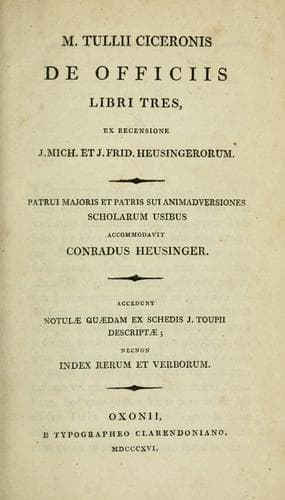
Philosophical study had its place, therefore, and the most important
department of philosophy was ethics. The treatise on Moral Duties has
the very practical purpose of giving a practical discussion of the basic
principles of Moral Duty and practical rules for personal conduct.
As a philosopher, if we may so stretch the term as to include him,
Cicero avows himself an adherent of the New Academy and a disciple of
Carneades. He had tried Epicureanism under Phaedrus and Zeno, Stoicism
under Diodotus and Posidonius; but Philo of Larissa converted him to the
New Academy.
Scepticism declared the attainment of absolute knowledge impossible. But
there is the easily obtainable golden mean of the probable; and that
appealed to the practical Roman. It appealed especially to Cicero; and
the same indecision that had been his bane in political life naturally
led him first to scepticism, then to eclecticism, where his choice is
dictated by his bias for the practical and his scepticism itself
disappears from view. And while Antiochus, the eclectic Academician of
Athens, and Posidonius, the eclectic Stoic of Rhodes, seem to have had
the strongest influence upon him, he draws at his own discretion from
the founts of Stoics, Peripatetics, and Academicians alike; he has only
contempt for the Epicureans, Cynics, and Cyrenaics. But the more he
studied and lived, the more of a Stoic in ethics he became.
Public-domain text, read in full here on John Shaqi.
Reviews
Reviews
No reviews yet
Be the first to share your thoughts on this work.
Join the Discussion
Join the discussion
Sign in to leave a comment or review.
Sign InorCreate an account