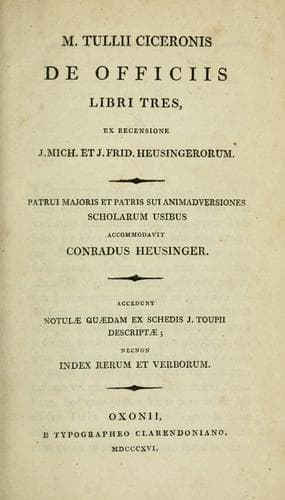
Well, then, the first thing to recommend to a young man in his quest for
glory is that he try to win it, if he can, in a military career. Among
our forefathers many distinguished themselves as soldiers; for warfare
was almost continuous then. The period of your own youth, however, has
coincided with that war in which the one side was too prolific in crime,
the other in failure. And yet, when Pompey placed you in command of a
cavalry squadron in this war, you won the applause of that great man and
of the army for your skill in riding and spear-throwing and for
endurance of all the hardships of the soldier's life. But that credit
accorded to you came to nothing along with the fall of the republic.
The subject of this discussion, however, is not your personal history,
but the general theme. Let us, therefore, proceed to the sequel.
#(2) by personal character,#
*46* As, then, in everything else brain-work is far more important than
mere hand-work, so those objects which we strive to attain through
intellect and reason gain for us a higher degree of gratitude than those
which we strive to gain by physical strength. The best recommendation,
then, that a young man can have to popular esteem proceeds from
self-restraint, filial affection, and devotion to kinsfolk. #(3) by
association with the great,# Next to that, young men win recognition
most easily and most favourably, if they attach themselves to men who
are at once wise and renowned as well as patriotic counsellors in public
affairs. And if they associate constantly with such men, they inspire in
the public the expectation that they will be like them, seeing that they
have themselves selected them for imitation. *47* His frequent visits
to the home of Publius Mucius assisted young Publius Rutilius to gain a
reputation for integrity of character and for ability as a jurisconsult.
Not so, however, Lucius Crassus; for though he was a mere boy, he looked
to no one else for assistance, but by his own unaided ability he won for
himself in that brilliant and famous prosecution[AO] a splendid
reputation as an orator. And at an age when young men are accustomed
with their school exercises to win applause as students of oratory, this
Roman Demosthenes, Lucius Crassus, was already proving himself in the
law-courts a master of the art which he might even then have been
studying at home with credit to himself.
[AO] At the age of 21 Crassus conducted the case against
Gaius Papirius Carbo, a former supporter of the Gracchi. The
prosecution was so ably conducted that Carbo committed
suicide to escape certain condemnation.
Public-domain text, read in full here on John Shaqi.
Reviews
Reviews
No reviews yet
Be the first to share your thoughts on this work.
Elsewhere in the archive
Join the Discussion
Join the discussion
Sign in to leave a comment or review.
Sign InorCreate an account