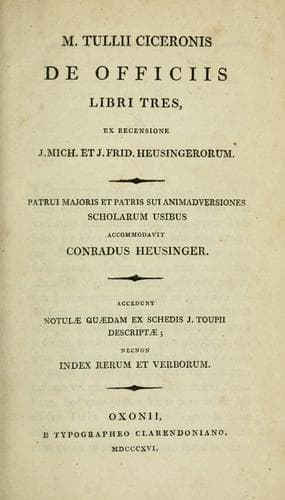
The cap-sheaf of Cicero's ethical studies is the treatise on the Moral
Duties. It takes the form of a letter addressed to his son Marcus (see
Index), at this time a youth of twenty-one, pursuing his university
studies in the Peripatetic school of Cratippus in Athens, and sowing for
what promised to be an abundant crop of wild oats. This situation gives
force and definiteness to the practical tendencies of the father's
ethical teachings. And yet, be it observed, that same father is not
without censure for contributing to his son's extravagant and riotous
living by giving him an allowance of nearly £870 a year.
Our Roman makes no pretensions to originality in philosophic thinking.
He is a follower--an expositor--of the Greeks. As the basis of his
discussion of the Moral Duties he takes the Stoic Panaetius of Rhodes
(see Index), Περὶ Καθήκοντος, drawing also from many other sources, but
following him more or less closely in Books I and II; Book III is more
independent and much inferior. He is usually superficial and not always
clear. He translates and paraphrases Greek philosophy, weaving in
illustrations from Roman history and suggestions of Roman mould in a
form intended to make it, if not popular, at least comprehensible, to
the Roman mind. How well he succeeded is evidenced by the comparative
receptivity of Roman soil prepared by Stoic doctrine for the teachings
of Christianity. Indeed, Anthony Trollope labels our author the "Pagan
Christian." "You would fancy sometimes," says Petrarch, "it is not a
Pagan philosopher but a Christian apostle who is speaking." No less an
authority than Frederick the Great has called our book "the best work on
morals that has been or can be written." Cicero himself looked upon it
as his masterpiece.
It has its strength and its weakness--its sane common sense and noble
patriotism, its self-conceit and partisan politics; it has the master's
brilliant style, but it is full of repetitions and rhetorical
flourishes, and it fails often in logical order and power; it rings true
in its moral tone, but it shows in what haste and distraction it was
composed; for it was not written as a contribution to close scientific
thinking; it was written as a means of occupation and diversion.
BIBLIOGRAPHY
The following works are quoted in the critical notes:--
_MSS._ A = _codex Ambrosianus_. Milan. 10th century.
B = _codex Bambergensis_. Hamburg. 10th century.
H = _codex Herbipolitanus_. Würzburg. 10th century.
L = _codex Harleianus_. London. 9th century.
a b = _codices Bernenses_. Bern. 10th century.
c = _codex Bernensis_. Bern. 13th century.
p = _codex Palatinus_. Rome. 12th century.
Public-domain text, read in full here on John Shaqi.
Reviews
Reviews
No reviews yet
Be the first to share your thoughts on this work.
Join the Discussion
Join the discussion
Sign in to leave a comment or review.
Sign InorCreate an account