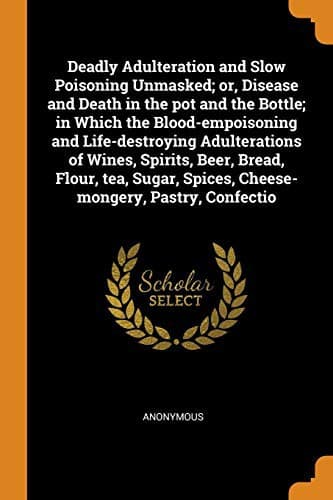
Deadly Adulteration and Slow Poisoning Unmasked: Disease and Death in the Pot and BottleAnonymous
Science
Deadly Adulteration and Slow Poisoning Unmasked: Disease and Death in the Pot and Bottle
Anonymous
Drug adulteration; Food adulteration and inspection
But the perfection of adulteration is in gin,—cheap gin—“the _real_
comfort,”—patronized by the poor for its supposed GENUINENESS! This
infernal compound of combustibles is distinguished from the other slow
poisons to which a large portion of the population of “the queen of
cities,”—our “modern Carthage,” make themselves the willing victims,
by the poisonous nature of the ingredients of which it is composed.[E]
These are the oils of vitriol, turpentine, juniper, cassia, carraways,
and almonds, sulphuric ether or phosphorus, extracts of orris-root,
angelica-root, capsicums or grains of paradise, sugar, and heading. The
aid of lime-water and of spirits of wine is also invoked in the course
of the operation. The purposes of these mischievous ingredients are as
follow: The oil of vitriol is to impart pungency and the appearance
of strength, when the liquor is applied to the nose, while the extract
of capsicums or of grains of paradise is designed to perform the same
office for the taste. The extracts of orris and angelica roots give a
fulness of body and the coveted flavour called cordial to the large
proportion of the compound, which consists only of water. The remaining
oils are to give strength, the sugar to sweeten the composition, and
the lime to unite the oils with the spirit; while the sulphuric ether,
phosphorus, and heading are intended to give the semblance of being
highly spirituous from the fiery taste, and the appearance of the light
bead which is caused to appear and remain for some time on the surface
of the noxious compound. The introduction of the white arsenic is
intended to promote an irritable and feverish thirst, so that the poor
deluded consumer may be compelled to have recourse to fresh potations
of the “liquid fire.” The Hollands of the gin-shop keepers and
advertising dealers is a commixture of a small portion of the genuine
article with rectified spirits, peppermint, cloves, &c. The cordial,
called Shrub, says Mr. Accum, Culinary Poisons, p. 257, frequently
exhibits vestiges of copper, which arise from the metallic vessels
employed in the manufacture of the liquor. But, had that ingenious
gentleman been thoroughly acquainted with the manufacture of shrub in
the cellars of spirit dealers, he would not have been quite so moderate
in his remarks respecting this seductive “_cordial_.”
Public-domain text, read in full here on John Shaqi.
Reviews
Reviews
No reviews yet
Be the first to share your thoughts on this work.
Join the Discussion
Join the discussion
Sign in to leave a comment or review.
Sign InorCreate an account