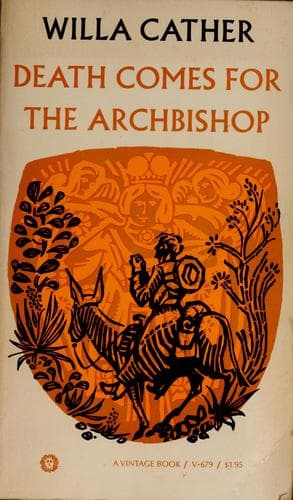
Christian fiction; Clergy -- Fiction; Historical fiction; New Mexico -- Fiction
Father Latour had looked forward to meeting the scout. He had supposed
him to be a very large man, of powerful body and commanding presence.
This Carson was not so tall as the Bishop himself, was very slight in
frame, modest in manner, and he spoke English with a soft Southern
drawl. His face was both thoughtful and alert; anxiety had drawn a
permanent ridge between his blue eyes. Under his blond moustache his
mouth had a singular refinement. The lips were full and delicately
modelled. There was something curiously unconscious about his mouth,
reflective, a little melancholy,--and something that suggested a
capacity for tenderness. The Bishop felt a quick glow of pleasure in
looking at the man. As he stood there in his buckskin clothes one felt
in him standards, loyalties, a code which is not easily put into words
but which is instantly felt when two men who live by it come together by
chance. He took the scout's hand. "I have long wanted to meet Kit
Carson," he said, "even before I came to New Mexico. I have been hoping
you would pay me a visit at Santa Fé."
The other smiled. "I'm right shy, sir, and I'm always afraid of being
disappointed. But I guess it will be all right from now on."
This was the beginning of a long friendship.
On their ride back to Carson's ranch, Magdalena was put in Father
Vaillant's care, and the Bishop and the scout rode together. Carson said
he had become a Catholic merely as a matter of form, as Americans
usually did when they married a Mexican girl. His wife was a good woman
and very devout; but religion had seemed to him pretty much a woman's
affair until his last trip to California. He had been sick out there,
and the Fathers at one of the missions took care of him. "I began to see
things different, and thought I might some day be a Catholic in earnest.
I was brought up to think priests were rascals, and that the nuns were
bad women,--all the stuff they talk back in Missouri. A good many of the
native priests here bear out that story. Our Padre Martinez at Taos is
an old scapegrace, if ever there was one; he's got children and
grandchildren in almost every settlement around here. And Padre Lucero
at Arroyo Hondo is a miser, takes everything a poor man's got to give
him a Christian burial."
Public-domain text, read in full here on John Shaqi.
Reviews
Reviews
No reviews yet
Be the first to share your thoughts on this work.
Join the Discussion
Join the discussion
Sign in to leave a comment or review.
Sign InorCreate an account