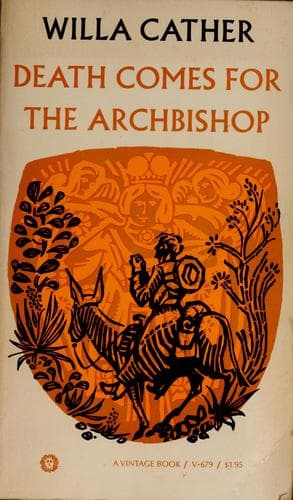
Christian fiction; Clergy -- Fiction; Historical fiction; New Mexico -- Fiction
The Bishop discussed the needs of his people at length with Carson. He
felt great confidence in his judgment. The two men were about the same
age, both a little over forty, and both had been sobered and sharpened
by wide experience. Carson had been guide in world-renowned
explorations, but he was still almost as poor as in the days when he was
a beaver trapper. He lived in a little adobe house with his Mexican
wife. The great country of desert and mountain ranges between Santa Fé
and the Pacific coast was not yet mapped or charted; the most reliable
map of it was in Kit Carson's brain. This Missourian, whose eye was so
quick to read a landscape or a human face, could not read a printed
page. He could at that time barely write his own name. Yet one felt in
him a quick and discriminating intelligence. That he was illiterate was
an accident; he had got ahead of books, gone where the printing-press
could not follow him. Out of the hardships of his boyhood--from fourteen
to twenty picking up a bare living as cook or mule-driver for wagon
trains, often in the service of brutal and desperate characters--he had
preserved a clean sense of honour and a compassionate heart. In talking
to the Bishop of poor Magdalena he said sadly: "I used to see her in
Taos when she was such a pretty girl. Ain't it a pity?"
The degenerate murderer, Buck Scales, was hanged after a short trial.
Early in April the Bishop left Santa Fé on horseback and rode to St.
Louis, on his way to attend the Provincial Council at Baltimore. When he
returned in September, he brought back with him five courageous nuns,
Sisters of Loretto, to found a school for girls in letterless Santa Fé.
He sent at once for Magdalena and took her into the service of the
Sisters. She became housekeeper and manager of the Sisters' kitchen. She
was devoted to the nuns, and so happy in the service of the Church that
when the Bishop visited the school he used to enter by the
kitchen-garden in order to see her serene and handsome face. For she
became beautiful, as Carson said she had been as a girl. After the
blight of her horrible youth was over, she seemed to bloom again in the
household of God.
BOOK THREE
_THE MASS AT ÁCOMA_
1
THE WOODEN PARROT
DURING the first year after his arrival in Santa Fé, the Bishop was
actually in his diocese only about four months. Six months of that first
year were consumed in attending the Plenary Council at Baltimore, to
which he had been summoned. He went on horseback over the Santa Fé
trail to St. Louis, nearly a thousand miles, then by steamboat to
Pittsburgh, across the mountains to Cumberland, and on to Washington by
the new railroad. The return journey was even slower, as he had with him
the five nuns who came to found the school of Our Lady of Light. He
reached Santa Fé late in September.
Public-domain text, read in full here on John Shaqi.
Reviews
Reviews
No reviews yet
Be the first to share your thoughts on this work.
Join the Discussion
Join the discussion
Sign in to leave a comment or review.
Sign InorCreate an account