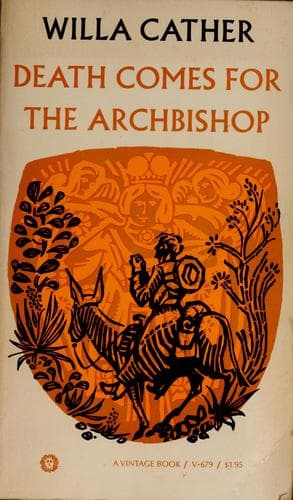
Christian fiction; Clergy -- Fiction; Historical fiction; New Mexico -- Fiction
The traveller was Jean Marie Latour, consecrated Vicar Apostolic of New
Mexico and Bishop of Agathonica _in partibus_ at Cincinnati a year
ago--and ever since then he had been trying to reach his Vicarate. No
one in Cincinnati could tell him how to get to New Mexico--no one had
ever been there. Since young Father Latour's arrival in America, a
railroad had been built through from New York to Cincinnati; but there
it ended. New Mexico lay in the middle of a dark continent. The Ohio
merchants knew of two routes only. One was the Santa Fé trail from St.
Louis, but at that time it was very dangerous because of Comanche Indian
raids. His friends advised Father Latour to go down the river to New
Orleans, thence by boat to Galveston, across Texas to San Antonio, and
to wind up into New Mexico along the Rio Grande valley. This he had
done, but with what misadventures!
His steamer was wrecked and sunk in the Galveston harbour, and he had
lost all his worldly possessions except his books, which he saved at the
risk of his life. He crossed Texas with a traders' caravan, and
approaching San Antonio he was hurt in jumping from an overturning
wagon, and had to lie for three months in the crowded house of a poor
Irish family, waiting for his injured leg to get strong.
It was nearly a year after he had embarked upon the Mississippi that the
young Bishop, at about the sunset hour of a summer afternoon, at last
beheld the old settlement toward which he had been journeying so long:
The wagon train had been going all day through a greasewood plain, when
late in the afternoon the teamsters began shouting that over yonder was
the Villa. Across the level, Father Latour could distinguish low brown
shapes, like earthworks, lying at the base of wrinkled green mountains
with bare tops,--wave-like mountains, resembling billows beaten up from
a flat sea by a heavy gale; and their green was of two colors--aspen and
evergreen, not intermingled but lying in solid areas of light and dark.
As the wagons went forward and the sun sank lower, a sweep of red
carnelian-coloured hills lying at the foot of the mountains came into
view; they curved like two arms about a depression in the plain; and in
that depression, was Santa Fé, at last! A thin, wavering adobe town ...
a green plaza ... at one end a church with two earthen towers that rose
high above the flatness. The long main street began at the church, the
town seemed to flow from it like a stream from a spring. The church
towers, and all the low adobe houses, were rose colour in that light,--a
little darker in tone than the amphitheatre of red hills behind; and
periodically the plumes of poplars flashed like gracious accent
marks,--inclining and recovering themselves in the wind.
Public-domain text, read in full here on John Shaqi.
Reviews
Reviews
No reviews yet
Be the first to share your thoughts on this work.
Join the Discussion
Join the discussion
Sign in to leave a comment or review.
Sign InorCreate an account