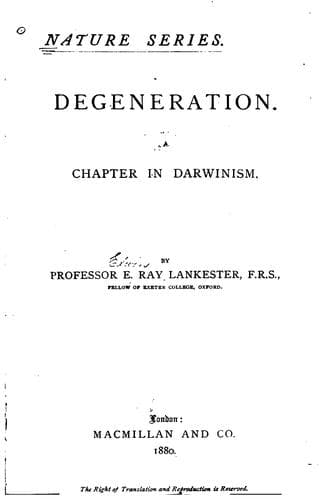
Degeneration: A Chapter in DarwinismLankester, E. Ray (Edwin Ray), Sir
Science
Degeneration: A Chapter in Darwinism
Lankester, E. Ray (Edwin Ray), Sir
Degeneration; Evolution (Biology)
And now we have to note an important fact with regard to the _evidence_
which we can obtain of the occurrence of this process of degeneration. We
have seen that the most conclusive evidence is that of the recapitulative
development of the individual. The Ascidian Phallusia shows itself to
be a degenerate Vertebrate by beginning life as a tadpole. But such
recapitulative development is by no means the rule. Quite arbitrarily,
we find, it is exhibited in one animal and not in a nearly allied kind.
Thus very many animals belonging to the Ascidian group have no tadpole
young—just as some tree-frogs have no tadpoles. It is quite possible,
and often, more often than not, occurs, that _the most important part_
of the recapitulative phases are absent from the developmental history
of an animal. The egg proceeds very rapidly to produce the adult form,
and all the wonderful series of changes showing the animal’s ancestry are
absolutely and completely omitted; that is to say, all those stages which
are of importance for our present purpose. Just as certain bodies pass
from the solid to the liquid state at a bound, omitting all intermediate
phases of consistence, but giving evidence of “internal work” by the
suggestive phenomenon of latent heat—so do these embryos skip long tracts
in the historically continuous phases of form, and present to us only the
intangible correlative “internal work” in place of the tangible series of
embryonic changes of shape.
Now I want to put this case—a supposition—before the reader who has so
far followed me in these pages. Suppose, as might well have happened,
that the Barnacles, one and all, instead of recapitulating in their early
life, were to develop _directly from the egg to the adult form_, as so
many animals do; should we have ever made out that they were degenerate
Crustaceans? Possibly we should: their adult structure still bears
important marks of affinities with crabs and shrimps; but as a matter of
fact before their recapitulative development had been discovered they
were classed by the great Cuvier and other naturalists with the Molluscs,
the mussels and snails.
Public-domain text, read in full here on John Shaqi.
Reviews
Reviews
No reviews yet
Be the first to share your thoughts on this work.
Join the Discussion
Join the discussion
Sign in to leave a comment or review.
Sign InorCreate an account