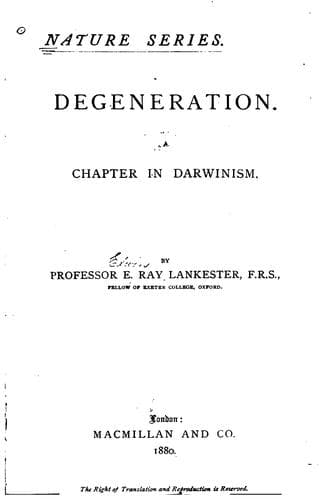
Degeneration: A Chapter in DarwinismLankester, E. Ray (Edwin Ray), Sir
Science
Degeneration: A Chapter in Darwinism
Lankester, E. Ray (Edwin Ray), Sir
Degeneration; Evolution (Biology)
Suppose again that _all_ the existing Ascidians, as many of them actually
have, had long ago lost their recapitulative history in growth from the
egg: suppose that no such a thing as an Ascidian tadpole existed, but
that the Ascidian’s egg grew as directly as possible into an Ascidian, in
every living species of the group. This might easily be the case. Then
most assuredly we should not have the least notion that the Ascidians
were degenerate Vertebrates. We should still class them where they used
to be classed before the Russian naturalist Kowalewsky discovered the
true history and structure of the Ascidian tadpole. I believe that I
shall have the assent of every naturalist when I say that the vertebrate
character of the Ascidians and the history of their degeneration
would never have been suspected, or even dreamed of, had the Ascidian
tadpoles ceased to appear in the course of the Ascidian development at a
geological period anterior to the present epoch.
This being the case, it must be admitted that it is quite _possible_—I
do not say more than possible—that other groups of animals besides
parasites, Barnacles, and Ascidians, are degenerate. It is quite possible
that animals with considerable complexity of structure, at least as
complex as the Ascidians, may have been produced by degeneration from
still more highly-organized ancestors. Any group of animals to which we
can turn may possibly be the result of degeneration, and yet offer no
evidence of that degeneration in its growth from the egg.
Public-domain text, read in full here on John Shaqi.
Reviews
Reviews
No reviews yet
Be the first to share your thoughts on this work.
Join the Discussion
Join the discussion
Sign in to leave a comment or review.
Sign InorCreate an account