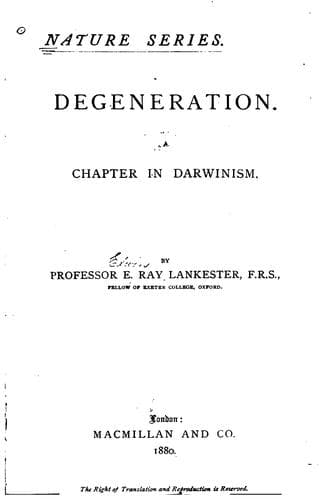
Degeneration: A Chapter in DarwinismLankester, E. Ray (Edwin Ray), Sir
Science
Degeneration: A Chapter in Darwinism
Lankester, E. Ray (Edwin Ray), Sir
Degeneration; Evolution (Biology)
With regard to ourselves, the white races of Europe, the possibility of
degeneration seems to be worth some consideration. In accordance with a
tacit assumption of universal progress—an unreasoning optimism—we are
accustomed to regard ourselves as necessarily progressing, as necessarily
having arrived at a higher and more elaborated condition than that which
our ancestors reached, and as destined to progress still further. On the
other hand, it is well to remember that we are subject to the general
laws of evolution, and are as likely to degenerate as to progress. As
compared with the immediate forefathers of our civilisation—the ancient
Greeks—we do not appear to have improved so far as our bodily structure
is concerned, nor assuredly so far as some of our mental capacities are
concerned. Our powers of perceiving and expressing beauty of form have
certainly _not_ increased since the days of the Parthenon and Aphrodite
of Melos. In matters of the reason, in the development of intellect, we
may seriously inquire how the case stands. Does the reason of the average
man of civilised Europe stand out clearly as an evidence of progress when
compared with that of the men of bygone ages? Are all the inventions and
figments of human superstition and folly, the self-inflicted torturing of
mind, the reiterated substitution of wrong for right, and of falsehood
for truth, which disfigure our modern civilisation—are these evidences of
progress? In such respects we have at least reason to fear that we may
be degenerate. Possibly we are all drifting, tending to the condition
of intellectual Barnacles or Ascidians. It is possible for us—just as
the Ascidian throws away its tail and its eye and sinks into a quiescent
state of inferiority—to reject the good gift of reason with which every
child is born, and to degenerate into a contented life of material
enjoyment accompanied by ignorance and superstition. The unprejudiced,
all-questioning spirit of childhood may not inaptly be compared to the
tadpole tail and eye of the young Ascidian: we have to fear lest the
prejudices, pre-occupations, and dogmatism of modern civilisation should
in any way lead to the atrophy and loss of the valuable mental qualities
inherited by our young forms from primæval man.
Public-domain text, read in full here on John Shaqi.
Reviews
Reviews
No reviews yet
Be the first to share your thoughts on this work.
Join the Discussion
Join the discussion
Sign in to leave a comment or review.
Sign InorCreate an account