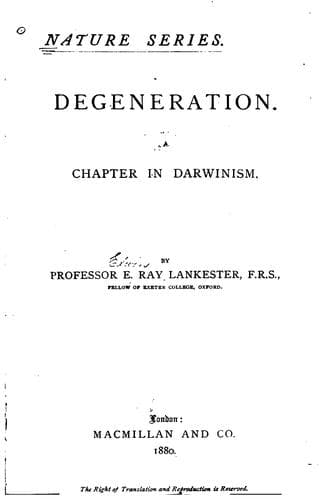
Degeneration: A Chapter in DarwinismLankester, E. Ray (Edwin Ray), Sir
Science
Degeneration: A Chapter in Darwinism
Lankester, E. Ray (Edwin Ray), Sir
Degeneration; Evolution (Biology)
All that has been, thus far, here said on the subject of Degeneration is
so much zoological specialism, and may appear but a narrow restriction of
the discussion to those who are not zoologists. Though we may establish
the hypothesis most satisfactorily by the study of animal organization
and development, it is abundantly clear that degenerative evolution
is by no means limited in its application to the field of zoology. It
clearly offers an explanation of many vegetable phenomena, and is already
admitted by botanists as the explanation of the curious facts connected
with the reproductive process in the higher plants. As a further example
of its application in this field, the yeast-plant may be adduced, which
is in all probability a degenerate floating form derived from a species
of mould (Mucor). In other fields, wherever in fact the great principle
of evolution has been recognised, degeneration plays an important part.
In tracing the development of languages, philologists have long made
use of the hypothesis of degeneration. Under certain conditions, in the
mouths and minds of this or that branch of a race, a highly elaborate
language has sometimes degenerated and become no longer fit to express
complex or subtle conceptions, but only such as are simpler and more
obvious. (See Note D.)
The traditional history of mankind furnishes us with notable examples of
degeneration. High states of civilisation have decayed and given place to
low and degenerate states. At one time it was a favourite doctrine that
the savage races of mankind were degenerate descendants of the higher and
civilised races. This general and sweeping application of the doctrine
of degeneration has been proved to be erroneous by careful study of the
habits, arts, and beliefs of savages; at the same time there is no doubt
that many savage races as we at present see them are actually degenerate
and are descended from ancestors possessed of a relatively elaborate
civilisation. As such we may cite some of the Indians of Central America,
the modern Egyptians, and even the heirs of the great oriental monarchies
of præ-Christian times. Whilst the hypothesis of universal degeneration
as an explanation of savage races has been justly discarded, it yet
appears that degeneration has a very large share in the explanation
of the condition of the most barbarous races, such as the Fuegians,
the Bushmen, and even the Australians. They exhibit evidence of being
descended from ancestors more cultivated than themselves.
Public-domain text, read in full here on John Shaqi.
Reviews
Reviews
No reviews yet
Be the first to share your thoughts on this work.
Join the Discussion
Join the discussion
Sign in to leave a comment or review.
Sign InorCreate an account