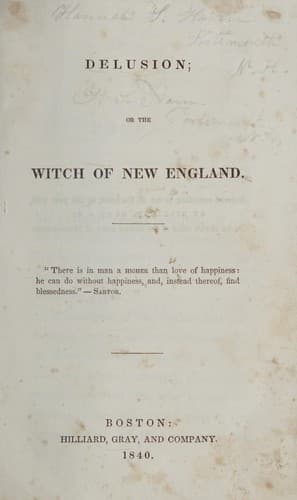
Delusion; or, The Witch of New EnglandLee, Eliza Buckminster
History
Delusion; or, The Witch of New England
Lee, Eliza Buckminster
Paranormal fiction; Salem (Mass.) -- History -- Colonial period, ca. 1600-1775 -- Fiction; Witchcraft -- New England -- Fiction
Like all who love deeply, she had dated her existence from the time she
became acquainted with Seymore: all before had become a blank in her
memory; but now her early years rose up before her, like the reflected
sunlight on distant hills. The thought of her father came back with
melting tenderness. Ah, now was he avenged for the short forgetfulness
with which she had ever reproached herself.
She threw herself on her knees, and prayed silently. She felt calmed and
elevated, as if in immediate answer to her prayer. All selfish and
agitating emotions passed away. A spirit of forgiveness, of endurance,
of calm and patient trust, entered her soul. She felt that, with
Seymore's convictions and sense of duty, he could not have acted
otherwise; he could not but bear his testimony to what he thought truth;
and almost a divine pity for his errors, and a purer love for his truth,
filled her heart.
She was informed that Seymore was waiting to see her. This was a trial
she had expected, and she was now prepared to meet him. He entered
trembling, pale, and wholly unmanned. As he tried to speak, his voice
failed, and he burst into tears.
It is fearful to see a strong man weep. Edith was not prepared for this
excess of emotion. Those who have seen Retch's exquisite drawing of
Cordelia when Lear awakes, and she asks "if he knows her," can imagine
the tender pity of her expression as she went to him and placed her hand
in his. A sweet smile was on her lips,--that smile that shows that woman
can mingle an infinite tenderness with the forgiveness of every injury.
He pressed her hand to his heart--his lips; and when he caught her
eye,--"O, do not look so mildly at me," he said; "reproach me, scorn me,
hate me: I can bear all rather than those meek eyes,--than that
forgiving smile."
"Be calm, dear Seymore," she said; "with your convictions, you could not
have done otherwise. You believe in the reality of these possessions.
The evidence against me was more and stronger than has been sufficient
to condemn many as innocent as I am. You can have no cause for
self-reproach."
"Innocent! O, say not that you are innocent! God has many ways of trying
his elect. You he has tried severely with temptations from the prince of
evil. He chooses souls like yours. O, Edith, for my sake, for your own
sake, acknowledge that you have been tempted. It only is required that
you should say you have been deceived; then all will be well."
For a moment, Edith's face was crimsoned. "What! become a traitor to my
own soul! lose forever the unsullied jewel of truth, and the peace of a
pure conscience! and do you counsel this?"
"Many have confessed," he said, "many of undoubted truth, of ripe
wisdom, who could not be deceived, and who would not confess to a
lie."[4]
Public-domain text, read in full here on John Shaqi.
Reviews
Reviews
No reviews yet
Be the first to share your thoughts on this work.
Elsewhere in the archive
Join the Discussion
Join the discussion
Sign in to leave a comment or review.
Sign InorCreate an account