Den Hunting as a Means of Coyote Control — John Shaqi
Den Hunting as a Means of Coyote ControlYoung, Stanley Paul
Science
Den Hunting as a Means of Coyote Control
Young, Stanley Paul
Coyote -- Control
Transcriber Notes
Text emphasis denoted as _Italics_.
Den Hunting
as a Means
of Coyote Control
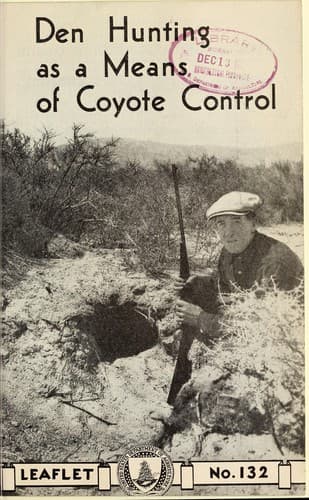
[Illustration: LEAFLET No. 132]
DEN HUNTING AS A MEANS OF COYOTE CONTROL
By Stanley P. Young, _principal biologist and chief of division_, and
Harold W. Dobyns, _assistant leader, Section of Predator and Rodent
Control, Division of Game Management, Bureau of Biological Survey_
Issued October 1937
CONTENTS
Page
Importance of den hunting 2
Qualifications and equipment of the den hunter 2
Breeding habits and number of young 3
Denning sites and habits 3
Methods of den hunting 5
Activities of whelps 7
Removing whelps from dens 7
Trapping and shooting adults 8
Importance of Den Hunting
There is perhaps no better method of keeping down the increase of coyotes
than to destroy the newly born whelps before they abandon the dens to
shift for themselves. A little time spent in locating dens in April, May,
and June and destroying the whelps will save months of strenuous effort
trying to rid the range of the predators after they have reached maturity.
Coyotes are particularly destructive during the denning season because of
the need of extra food both for themselves and their young. Lambing bands
of sheep on open ranges suffer the heaviest losses. Coyotes that kill
lambs during April and May generally have dens, and when the dens are
located and the whelps destroyed, the sheep killing usually stops. Some
coyotes show great cunning in refraining from killing lambs near their
dens and will pass by a band of sheep that is herded right over a den
only to raid another several miles distant. They have been known to carry
leg of lamb a distance of 8 miles to their young in the den. Contrary
to the belief of stockmen and others, the male coyote is as destructive
as the female, and special attention to fresh kills at lambing time has
shown that the tracks of male coyotes are more in evidence than those of
the females.
Qualifications and Equipment of the Den Hunter
The most essential qualifications of a den hunter are keen observation,
persistence, and familiarity with the habits of coyotes. He can probably
become more skilled in den hunting than in any other phase of coyote
control. The denning habits of coyotes are similar in most sections,
and the same general methods of den hunting can be applied to humid
mountainous sections and to semiarid deserts.
Public-domain text, read in full here on John Shaqi.
Reviews
Reviews
No reviews yet
Be the first to share your thoughts on this work.
Join the Discussion
Join the discussion
Sign in to leave a comment or review.
Sign InorCreate an account