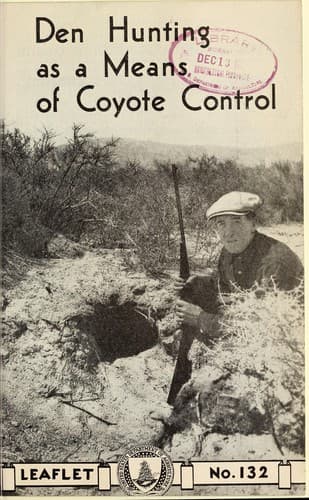
Den Hunting as a Means of Coyote ControlYoung, Stanley Paul
Science
Den Hunting as a Means of Coyote Control
Young, Stanley Paul
Coyote -- Control
"Den sign" means indications of denning activity and should always be
watched for. It may consist of tracks, a well-worn path leading to and
from a den, or holes freshly cleaned out. Holes made by the coyotes in
digging out squirrels or rabbits should not be confused, however, with
those prepared for dens. A good hunter will overlook no likely place and
should take advantage of every hint, for dens are often found where least
expected. He should look for den sign in every locality where animals
are frequently seen. He should keep in mind the places used by pairs of
coyotes and visit all old dens known, as sign may often be discovered
there at whelping time. Holes may be cleaned out in one canyon and the
den be just over the hill in another. Sheep herders on a range usually
can give valuable information as to locations of dens.
The equipment of a den hunter should include at least two good, gentle
saddle horses, a small shovel, a pair of good field glasses, a rifle of
not less than .25 caliber, and a dog. Coyotes are not so much afraid of a
man on horseback as of one on foot. A rider, therefore, can get many good
shots, and in heavy sagebrush he can more easily see and track coyotes
from his vantage seat upon a horse.
Breeding Habits and Number of Young
In the mating season coyotes may be heard yelping much more than usual,
and packs of three to a dozen animals may be seen. Later the breeding
animals pair off. Some pairs may remain together for a number of years,
but as a rule coyotes do not mate for life.
The whelping season varies with latitude. In general, according to
studies of a large number of embryos by G. W. D. Hamlett, of the
Biological Survey, the season in the northern tier of States seems
somewhat earlier than farther south; in Montana, for example, breeding
begins about February 1 and lasts throughout the month, the average date
being February 15. In Texas, breeding seems to begin somewhat later,
although data are inadequate for definite conclusions. In some States, as
in Oregon and Arizona, Hamlett found a variation of at least 2 months in
the time of breeding, probably because of great diversity in habitat. A
study on the spot, with due attention to altitude and other environmental
factors, would probably explain any unusual variation.
Coyote pups are born 60 to 63 days after breeding. Their eyes open when
they are 9 to 14 days old. The average number of young to the litter is
normally 7. Although there may be smaller litters when food is scarce, it
is not uncommon to find litters of 9 to 12 (fig. 1, A), and some females
have been known to have as many as 17 young. The only thing provided in
the nature of a nest is an enlarged section of the den, and some dens do
not have even this. The pups lie in the dry dust on the floor.
Public-domain text, read in full here on John Shaqi.
Reviews
Reviews
No reviews yet
Be the first to share your thoughts on this work.
Join the Discussion
Join the discussion
Sign in to leave a comment or review.
Sign InorCreate an account