Den Hunting as a Means of Coyote Control — John Shaqi
Den Hunting as a Means of Coyote ControlYoung, Stanley Paul
Science
Den Hunting as a Means of Coyote Control
Young, Stanley Paul
Coyote -- Control
Dens are often found to contain two litters, one consisting of young with
eyes not yet open and the other of pups about a month old. One litter
may be large and the other small, the latter probably belonging to a
young female that, apparently at a loss for a place to den, had taken up
quarters with her mother. Young females usually whelp about 10 days to
2 weeks later than the older ones. An occasional den may harbor three
litters. At a den where two litters are found there is usually only one
male, which would suggest polygamy.
Under normal conditions a pair of coyotes is found with every den unless
one parent has been killed. If this happens to be the female and the pups
are young, they die. If they are old enough to eat meat, the male parent
cares for them, as he does his part in providing food.
Denning Sites and Habits
Coyotes do not select denning sites according to any recognizable rule,
but many of them return to the same general locality year after year,
even though dens are regularly dug out and the pups killed by den
hunters. If the female is killed, the male may bring his new mate to the
same den the next season. A dug out den that has not been badly damaged
in removing coyotes may remain unoccupied for two or three seasons and
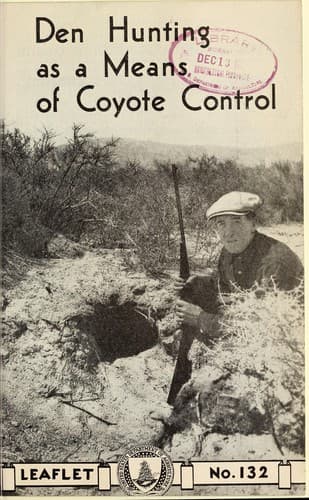
then be used again, as was the case with the den in Conejos County,
Colo., shown on the title page.
[Illustration: B27874; B4847A
Figure 1.--A, Coyote and a litter of 10 taken from a den
in San Luis Valley, Colo., in cooperative predator-control operations;
B, coyote den (directly beneath hunter) in a hillside thicket in rugged
country, Lance Creek, Wyo.]
Dens may be found in a canyon, wash-out, or coulee, on a bank or
hillside (fig. 1, B), in a rock bluff, or even in level ground, as in
a wheatfield, stubblefield, or plowed field. They have been discovered
under deserted homestead shacks in the desert, under grain bins, in a
drainage pipe, under a railroad, in a hollow log, in a thicket, and under
a clump of thistles that had blown into a canyon.
As a rule, instead of digging all new dens, coyotes will enlarge
abandoned badger or rabbit holes or use deserted porcupine dens in rocky
promontories or canyon walls. Usually they start cleaning out the holes
several weeks prior to whelping. They generally claw out the dirt in
one direction from the mouth of the den, where it piles up into a mound,
although some dens have no such mound (fig. 2, A).
Public-domain text, read in full here on John Shaqi.
Reviews
Reviews
No reviews yet
Be the first to share your thoughts on this work.
Join the Discussion
Join the discussion
Sign in to leave a comment or review.
Sign InorCreate an account