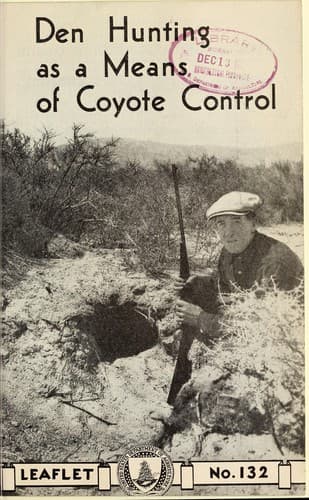
Den Hunting as a Means of Coyote ControlYoung, Stanley Paul
Science
Den Hunting as a Means of Coyote Control
Young, Stanley Paul
Coyote -- Control
A small dog trained to go into dens and bring out the whelps is useful.
Such dogs are scarce, but with careful handling, the proper breed
(wire-haired fox terrier or other terrier) soon learns and enjoys this
work. Any dog, however, is a great help, as the parent coyotes become
much alarmed if it nears their den and often set up a howl or series of
barks and yelps, thus betraying the fact that a den is near. A dog that
runs rabbits and hunts several hundred yards from the hunter is better
than one that follows at the horse's heels. A small dog is preferable.
Coyotes are likely to give wide berth to a large one, but will sometimes
fight and chase a small dog, thus presenting a good target for shots,
particularly when they go some distance from the den to fight the
intruder. For several days after the den has been destroyed females that
have lost their whelps frequently fight or chase any dog that comes near.
A 12-gage pump shotgun loaded with BB shot is good for hunting pups that
have left the dens but are still together. They may be found lying under
sagebrush or among the rocks and are more easily hit with a shotgun than
with a rifle when they start to scatter.
Trapping and Shooting Adults
A hunter should leave as few traces as possible of his visit to a den. He
should carry several traps, with which to try to capture the old coyotes.
It is well to set a few traps "blind"--that is, without bait or scent--in
the trails leading to the den, although some coyotes never return to a
den after a hunter has visited it. A good set can be made by burying a
dead whelp, leaving one foot exposed, and setting traps nearby. Holes
that have been cleaned out for dens make excellent places for trap sets,
particularly for catching females as they go in or out before whelping.
In such a situation, two traps should be set blind, one on each side
of the entrance or mound. Other favorable sites are the beds where old
coyotes lie, presumably on guard. These beds may be close to the den or
on a hillside or canyon rim half a mile away. Directions for trapping
coyotes are given in Department of Agriculture Leaflet No. 59.
When coyotes are sighted near their dens they are usually quiet, and some
good shots may be possible. A hunter should never dismount from his horse
when a coyote stops to watch him, but should wait until it starts moving
and then dismount on some high spot and be ready to shoot the instant it
stops again. If it does not stop of its own accord, a low whistle will
often bait it long enough to offer the hunter a good target.
* * * * *
U. S. GOVERNMENT PRINTING OFFICE: 1937
For sale by the Superintendent of Documents, Washington, D. C.
Price 5 cents
* * * * *
Transcriber Notes
Illustrations were moved so as to not split paragraphs.
Public-domain text, read in full here on John Shaqi.
Reviews
Reviews
No reviews yet
Be the first to share your thoughts on this work.
Join the Discussion
Join the discussion
Sign in to leave a comment or review.
Sign InorCreate an account