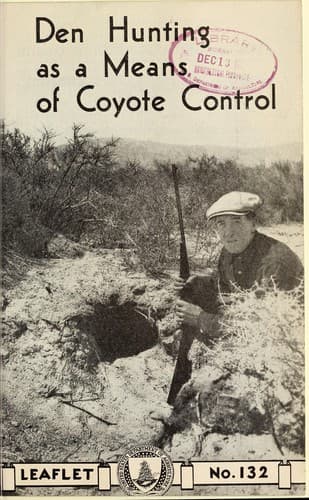
Den Hunting as a Means of Coyote Control — John Shaqi
Den Hunting as a Means of Coyote ControlYoung, Stanley Paul
Science
Den Hunting as a Means of Coyote Control
Young, Stanley Paul
Coyote -- Control
The digging necessary to capture pups depends largely on the nature
of the soil and the location of the den (fig. 2, B). Some dens are so
shallow that little digging is required; others cannot be dug out; and
some burrows lead straight into a bank or under a hardpan ledge. Much
work can be avoided by running a shovel handle or long stick as far as
possible into the hole to ascertain its direction and then digging a
pit down to the den instead of following the burrow. Where digging is
extremely difficult, the animals may be disturbed and induced to move,
frequently to a den from which they can be more readily taken. Usually
they move from a quarter of a mile to a mile away and can easily be
tracked. If pups can be seen back in a den but cannot be reached in
digging, a forked stick or a wire so twisted as to catch in their fur has
been employed to save labor; but if the den or burrow branches and turns,
such an instrument is never wholly satisfactory, as some of the whelps
are likely to be missed.
Before digging is begun, the den entrance should be blocked to prevent
the escape of the mother coyote, should she be inside the den. When the
pups are of suckling age she is often in the den with them, but when they
are old enough to play and be fed outside she seldom goes into it. It is
difficult to tell her whereabouts by her tracks, as she backs out of the
den unless disturbed and the tracks all appear as if made in entering.
Pups are wobbly on their legs when only 2 or 3 weeks old, so that if a
pit 18 inches deep is dug just outside the mouth of the den they fall
into it when they attempt to crawl out and are easily captured.
Smoking the young out of the den is not satisfactory as a rule but is
sometimes successful. A good smoker can be made by soldering a half-inch
hose coupling to the spout of a bellows-operated bee smoker and using
sulphur and pieces of burlap as fuel. A piece of garden hose about 10
feet long can be attached and worked down into the den close to the pups,
preferably behind them. The operator should stand back from the mouth of
the den, armed with a good club to dispatch the pups as they come out.
Throwing a handful of calcium cyanide into a den and stopping the hole
with dirt is an effective method of fumigation, but this chemical must be
handled with extreme care--as a rule by experienced workers only--as it
is also dangerous to man.
Public-domain text, read in full here on John Shaqi.
Reviews
Reviews
No reviews yet
Be the first to share your thoughts on this work.
Join the Discussion
Join the discussion
Sign in to leave a comment or review.
Sign InorCreate an account