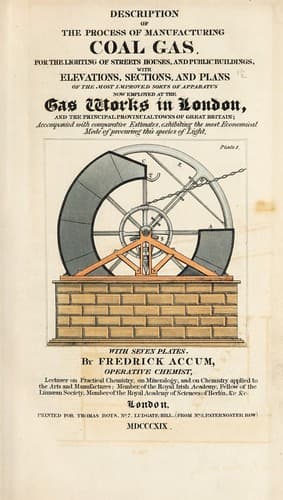
Description of the Process of Manufacturing Coal Gas, for the Lighting of Streets Houses, and Public Buildings: With Elevations, Sections, and Plans of the Most Improved Sorts of Apparatus Now Employed at the Gas Works in London and the Principal Provincial Towns of Great Britain; Accompanied With Comparative Estimates, Exhibiting the Most Economical Mode of Procuring This Species of Light — John Shaqi
Description of the Process of Manufacturing Coal Gas, for the Lighting of Streets Houses, and Public Buildings: With Elevations, Sections, and Plans of the Most Improved Sorts of Apparatus Now Employed at the Gas Works in London and the Principal Provincial Towns of Great Britain; Accompanied With Comparative Estimates, Exhibiting the Most Economical Mode of Procuring This Species of LightAccum, Friedrich Christian
History
Description of the Process of Manufacturing Coal Gas, for the Lighting of Streets Houses, and Public Buildings: With Elevations, Sections, and Plans of the Most Improved Sorts of Apparatus Now Employed at the Gas Works in London and the Principal Provincial Towns of Great Britain; Accompanied With Comparative Estimates, Exhibiting the Most Economical Mode of Procuring This Species of Light
Accum, Friedrich Christian
Gas manufacture and works -- Great Britain; Gas-lighting
The excessive expence of insurance, arising from the numerous candles
employed in most of the first-rate manufacturing establishments, and the
combustible nature of the structure of the buildings; the great
difficulty of retrieving the injury resulting to a well-organised
business, from the accidental destruction of the machinery, are
considerations alone sufficient to furnish the strongest economical, as
well as political recommendations, for the adoption of the new lights in
all manufactories where work is done by candle-light.
We have as yet only adverted to the application of gas in the more
ordinary cases where light is wanted, but among other special purposes
to which gas-lights may be applied, it would be improper to overlook the
peculiarly advantageous use which may be made of them in the supplying
of light-houses. From the splendour and distinguishing forms which the
gas-light flame is capable of assuming, nothing can possibly be better
calculated for such a purpose; and in point of economy, the employment
of it would be attended with a saving of at least one half of the
ordinary expence of oil lights. By means of a single furnace, as much
gas may be produced in three hours, as will furnish during the longest
winter night, a flame of greater brilliancy than is now furnished by any
lighthouse in Britain, or indeed in the world. The body of flame may be
increased to any size, merely by increasing the number of burners; and
whatever may be the magnitude of the flame, it will continue to burn,
without becoming in the least clouded by smoke, or the reflectors being
in the least obscured. Should these considerations lead, as it is to be
hoped they will, to the actual employment of gas in the lighthouses
around the British islands, it will readily occur, that in proportion as
the gas would be found attended with less expense than the present mode
of lighting by oil, it would enable the commissioners for light-houses,
out of the surplus means which would be thus placed at their disposal,
to multiply the number of lighthouses, and thus to add most essentially
to the security of British navigation. Nor is it in the case of maritime
signal-lights alone, that the use of gas is applicable, by its superior
efficacy and cheapness. The saving of expences to the country which
would be effected by the substitution of coal gas, for oil and tallow in
these and other public establishments, is a consideration which cannot
be too much pressed on public attention. The annual expenditure for
lighting the barracks of Great Britain alone, is said to fall little
short of fifty thousand pounds; for less than one half of which sum,
they might be lighted by means of gas much better, and a great deal more
safely. Some idea may be formed from the practical saving in this
department--how great might be the total saving, were this new mode of
lighting adopted in all our national establishments.
Public-domain text, read in full here on John Shaqi.
Reviews
Reviews
No reviews yet
Be the first to share your thoughts on this work.
Join the Discussion
Join the discussion
Sign in to leave a comment or review.
Sign InorCreate an account