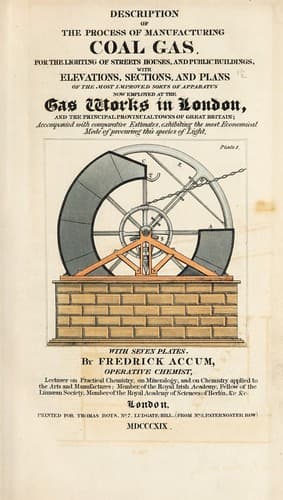
Description of the Process of Manufacturing Coal Gas, for the Lighting of Streets Houses, and Public Buildings: With Elevations, Sections, and Plans of the Most Improved Sorts of Apparatus Now Employed at the Gas Works in London and the Principal Provincial Towns of Great Britain; Accompanied With Comparative Estimates, Exhibiting the Most Economical Mode of Procuring This Species of LightAccum, Friedrich Christian
History
Description of the Process of Manufacturing Coal Gas, for the Lighting of Streets Houses, and Public Buildings: With Elevations, Sections, and Plans of the Most Improved Sorts of Apparatus Now Employed at the Gas Works in London and the Principal Provincial Towns of Great Britain; Accompanied With Comparative Estimates, Exhibiting the Most Economical Mode of Procuring This Species of Light
Accum, Friedrich Christian
Gas manufacture and works -- Great Britain; Gas-lighting
In the case of the public arsenals, however, the saving from the
employment of coal gas is a consideration of far inferior importance to
the _superior security_ attending it. On the preservation of the stores
which they contain may depend in a time of war the whole chance of
success against the enemy nor can any body who has lived in this
country at such a time have forgot the feverish alarm with which the
people have frequently seen this security endangered by accidents
arising from the use of moveable lights. Were coal gas exclusively
employed in such establishments, the fixed position which can be given
to the burners, and the absence of all danger from sparks must give a
degree of security to those places from fire, far beyond what they at
present possess, even when superintended with the greatest possible
caution and fidelity.
The same remark is equally applicable to the government offices, public
libraries, museums, in short, to all public establishments where the
national value of the articles preserved is such that no _possible_
means of increasing their security from destruction should be neglected.
We have now to turn our attention to another general point of view in
which the introduction of lighting by gas is not less an object of
interest to the public; we allude to the application of gas as a means
of _heating_ as well as lighting. Mr. Maiben[1] was the first who
directed the attention of the public to this subject; he ascertained
that gas from coal gives nearly the same heat when put into combustion,
which is yielded by a third part of the coal from which it is extracted.
In other words, it has been found that a quantity of fuel giving a
particular degree of heat, may be employed so as to produce at the same
time another substance yielding nearly an equal degree of heat in a
different and more manageable form; a form in which it can be preserved
for any length of time, divided into any portions, distributed in any
direction, consumed in an open fire-place, or in a stove concealed in
any shape; a form in which the flame may issue equally well from iron or
from stone-ware, be instantly lighted up and instantly extinguished, be
made to burn as long or as short a time as may suit us, and in any
degree of intensity between the most animating and brilliant blaze and
its total extinction; be extinguished in one room, and the next moment
lighted up in any other; in short such a form, that by one proper
arrangement from the beginning, with the same portion of fuel, we may at
any time have the command of a chearful fire, an adequate and
comfortable warmth in any part of our dwelling to which we may have
occasion to move, as manageable, and in this way as portable, as the
taper by the touch of which it is kindled. To those who have been
accustomed to see before them a solid mass of burning fuel, this gas
flame may at first have the less satisfactory appearance of a fugitive
blaze which we perceive nothing to support.
Public-domain text, read in full here on John Shaqi.
Reviews
Reviews
No reviews yet
Be the first to share your thoughts on this work.
Join the Discussion
Join the discussion
Sign in to leave a comment or review.
Sign InorCreate an account