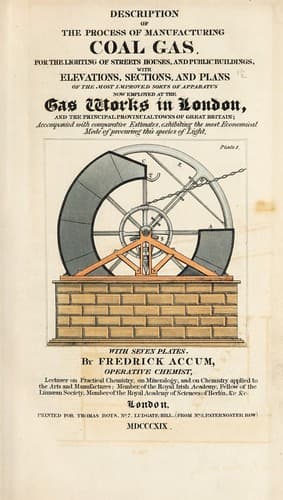
Description of the Process of Manufacturing Coal Gas, for the Lighting of Streets Houses, and Public Buildings: With Elevations, Sections, and Plans of the Most Improved Sorts of Apparatus Now Employed at the Gas Works in London and the Principal Provincial Towns of Great Britain; Accompanied With Comparative Estimates, Exhibiting the Most Economical Mode of Procuring This Species of LightAccum, Friedrich Christian
History
Description of the Process of Manufacturing Coal Gas, for the Lighting of Streets Houses, and Public Buildings: With Elevations, Sections, and Plans of the Most Improved Sorts of Apparatus Now Employed at the Gas Works in London and the Principal Provincial Towns of Great Britain; Accompanied With Comparative Estimates, Exhibiting the Most Economical Mode of Procuring This Species of Light
Accum, Friedrich Christian
Gas manufacture and works -- Great Britain; Gas-lighting
Such clamour scarcely ever fails to be made when the extension of
machinery, the application of inanimate power, and the abridgment of
labour consequent on either, is a matter proposed. We are then sure to
be told that the scheme of mechanical or chemical improvement is pointed
against the human species, that it tends to drive them out of the system
of beneficial employment and that, on the whole, the sum of the
improvement is not only a less proportion of good to society, but a
positive accession of misery to the unemployed poor.
The misfortune of this argument is that to be good for any thing, it
would prove a great deal too much. It is not confined in its scope to
any particular species or defined extent of improvement, but is equally
proscriptive of all improvements whatever. It is a principle for savage
life, not for a state of civilization. It takes for its basis that it is
an advantage to perpetuate that necessity for hard and incessant labour
under which man finds himself originally placed by nature, with all the
wants, privations, ignorance and ferocity, which are attendant on that
condition, and that every discovery, invention, or improvement which
tends to abridge the quantity required of human labour, and to augment
the resources for living and enjoyment is a serious injury to society.
The advocates of this narrow theory do not go the whole length of
maintaining that diminishing labour, and increase of substance, are in
themselves positive evils, a position too absurd perhaps for any one to
uphold; but they maintain what ends in a consequence nearly as untrue,
namely, that neither the one nor the other is of any advantage to
society at large. The palpable error of this theory is, that it supposes
that all improvements which tend to supersede human labour, are
necessarily made for the benefit of a few, and not for the common
benefit of the many; that instead of lessening to each individual the
share of labour requisite to obtain the means of his subsistence, their
only tendency is to lessen the value of each personas labour, and to
oblige him to work more in order to live equally well.
Public-domain text, read in full here on John Shaqi.
Reviews
Reviews
No reviews yet
Be the first to share your thoughts on this work.
Join the Discussion
Join the discussion
Sign in to leave a comment or review.
Sign InorCreate an account