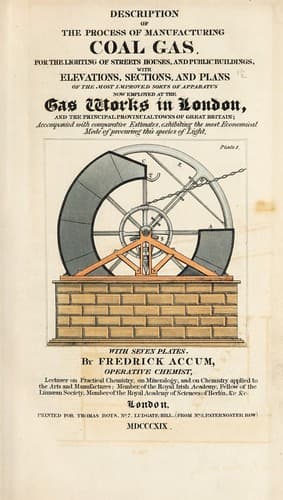
Description of the Process of Manufacturing Coal Gas, for the Lighting of Streets Houses, and Public Buildings: With Elevations, Sections, and Plans of the Most Improved Sorts of Apparatus Now Employed at the Gas Works in London and the Principal Provincial Towns of Great Britain; Accompanied With Comparative Estimates, Exhibiting the Most Economical Mode of Procuring This Species of Light — John Shaqi
Description of the Process of Manufacturing Coal Gas, for the Lighting of Streets Houses, and Public Buildings: With Elevations, Sections, and Plans of the Most Improved Sorts of Apparatus Now Employed at the Gas Works in London and the Principal Provincial Towns of Great Britain; Accompanied With Comparative Estimates, Exhibiting the Most Economical Mode of Procuring This Species of LightAccum, Friedrich Christian
History
Description of the Process of Manufacturing Coal Gas, for the Lighting of Streets Houses, and Public Buildings: With Elevations, Sections, and Plans of the Most Improved Sorts of Apparatus Now Employed at the Gas Works in London and the Principal Provincial Towns of Great Britain; Accompanied With Comparative Estimates, Exhibiting the Most Economical Mode of Procuring This Species of Light
Accum, Friedrich Christian
Gas manufacture and works -- Great Britain; Gas-lighting
Now, however the existing state of things may be in this country, or in
other countries, arising out of a variety of arbitrary circumstances,
foreign to the natural, and in all cases the ultimately inevitable
course of industry, it is a matter of justice, clear and undeniable,
that every improvement in society ought to be the property of the many,
and not of a few; and that it ought either to lessen the quantity of
labour necessary for acquiring the means of living, or to increase the
profit to be gained by continuing the same quantity of labour. Nor does
there seem any reason for believing that, in point of fact, the actual
distribution of things is so far from according with this principle of
justice as some superficial and prejudiced observers are fond of
representing. The labourer, or artizan, may now work a greater number of
hours daily than he did years ago; but how seldom do we find this to be
the case without his comforts being more than proportionally multiplied,
and his ultimate independence from labour essentially promoted. In
general, however, the fact is, if we may give credit to well informed
economists, that the working classes do not labour more than formerly,
and yet live, or at least have the means of living better; and that by
working even less than formerly, they can obtain the means of living
quite as well.
Let the real state of matters in this respect, however, be as it may,
the question comes to be one merely as to the distribution of the
produce of nature and of art, and instead of opposing improvements
because they tend to encrease that produce, the object of those who have
really the good of their fellow-creatures at heart, ought to be, to
encourage such improvements as much as possible, but at the same time to
obtain a correction of any partiality or injustice which may have crept
into the distribution of their beneficial consequences. It is not to be
denied that all new improvements which interfere with and change the
occupations and habits of the working classes of people, must at first
expose them to inconvenience and distress, against which it is in
fairness the duty of society to protect them; but let not that temporary
inconvenience and distress which can and ought to be provided against,
be held as an insuperable obstacle to the adoption of an improvement the
ultimate tendency of which it is to better the condition of mankind.
It is likewise true that the manufacturing classes often suffer great
want by the occasional suspension of employment, and sometimes actual
oppression, by the demand for labour; but that involves a question more
immediately connected with political economy than the present subject.
It is not the machinery that is in fault in such cases, but those
speculators who occasion an inordinate excess of employment, or those
statesmen who, with their folly, derange the great machine of human
interests and intercourse.
Public-domain text, read in full here on John Shaqi.
Reviews
Reviews
No reviews yet
Be the first to share your thoughts on this work.
Join the Discussion
Join the discussion
Sign in to leave a comment or review.
Sign InorCreate an account