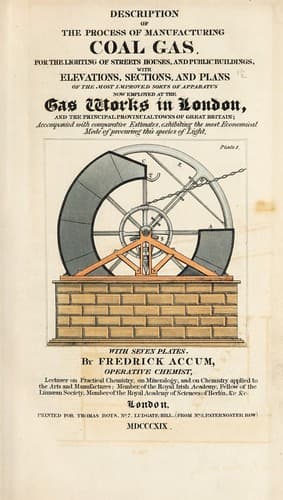
Description of the Process of Manufacturing Coal Gas, for the Lighting of Streets Houses, and Public Buildings: With Elevations, Sections, and Plans of the Most Improved Sorts of Apparatus Now Employed at the Gas Works in London and the Principal Provincial Towns of Great Britain; Accompanied With Comparative Estimates, Exhibiting the Most Economical Mode of Procuring This Species of Light — John Shaqi
Description of the Process of Manufacturing Coal Gas, for the Lighting of Streets Houses, and Public Buildings: With Elevations, Sections, and Plans of the Most Improved Sorts of Apparatus Now Employed at the Gas Works in London and the Principal Provincial Towns of Great Britain; Accompanied With Comparative Estimates, Exhibiting the Most Economical Mode of Procuring This Species of LightAccum, Friedrich Christian
History
Description of the Process of Manufacturing Coal Gas, for the Lighting of Streets Houses, and Public Buildings: With Elevations, Sections, and Plans of the Most Improved Sorts of Apparatus Now Employed at the Gas Works in London and the Principal Provincial Towns of Great Britain; Accompanied With Comparative Estimates, Exhibiting the Most Economical Mode of Procuring This Species of Light
Accum, Friedrich Christian
Gas manufacture and works -- Great Britain; Gas-lighting
The capillary tubes, formed by the wick of a candle, or lamp, serve the
office of the retorts, placed in the heated furnace in the gas-light
process and in which the inflammable gaseous fluid is developed. The wax
tallow or oil, is drawn up into these ignited tubes, and is decomposed
into carburetted hydrogen gas, and from the combustion of this substance
the illumination proceeds. In the lamp as well as in the candle, the
oil, or tallow, must therefore be decomposed before they can produce a
light, but for this purpose the decomposition of a minute quantity of
the materials successively, is sufficient to give a good light. Thus
originates the flame of a candle or lamp.
Nothing more therefore is aimed at in the gas-light process, than to
separate the immediate products which coal affords, when submitted to a
temperature of ignition in a close vessel; to collect these products in
separate reservoirs, and to convey one of the products, the inflammable
gas, by means of pipes and branching tubes, to any required distance, in
order to exhibit it there at the orifice of the conducting tube, so that
it may be used as a candle or lamp.
The whole difference between the gigantic process of the gas light
operation, and the miniature operation of a candle or lamp, consists in
having the distillatory apparatus at the gas-light manufactory, instead
of being in the wick of a candle or lamp. In having the crude
inflammable matter decomposed previous to the elastic fluid being
wanted, and stored up for use, instead of being prepared and consumed as
fast as it proceeds from the decomposed oil, wax or tallow; and lastly,
in transmitting the gas to any required distance, and igniting it at
the burner or lamp of the conducting tube, instead of burning it at the
apex of the wick. The principle of the gas-light manufacture is
therefore rational, and justifiable by the general mode in which all
light is produced.
It only remains to be observed that while the new and important use to
which pitcoal may thus be applied, affords a strong confirmation of what
has been well observed, that of all subterraneous combustible
substances, coal is in this country by far the most important natural
production.[2] “It is connected not only with the necessities, comforts
and enjoyments of life, but also with the extension of our most
important arts, our manufactures, commerce and national riches.
[2] Davy on the Safety Lamp.
“Essential in affording warmth and preparing food, it yields a sort of
artificial sunshine and in some measure compensates for the
disadvantages of our climate.
Reviews
Reviews
No reviews yet
Be the first to share your thoughts on this work.
Join the Discussion
Join the discussion
Sign in to leave a comment or review.
Sign InorCreate an account