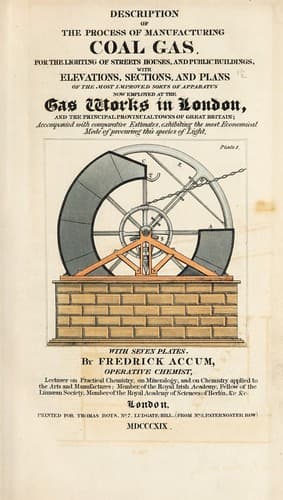
Description of the Process of Manufacturing Coal Gas, for the Lighting of Streets Houses, and Public Buildings: With Elevations, Sections, and Plans of the Most Improved Sorts of Apparatus Now Employed at the Gas Works in London and the Principal Provincial Towns of Great Britain; Accompanied With Comparative Estimates, Exhibiting the Most Economical Mode of Procuring This Species of LightAccum, Friedrich Christian
History
Description of the Process of Manufacturing Coal Gas, for the Lighting of Streets Houses, and Public Buildings: With Elevations, Sections, and Plans of the Most Improved Sorts of Apparatus Now Employed at the Gas Works in London and the Principal Provincial Towns of Great Britain; Accompanied With Comparative Estimates, Exhibiting the Most Economical Mode of Procuring This Species of Light
Accum, Friedrich Christian
Gas manufacture and works -- Great Britain; Gas-lighting
If coal instead of being burnt in the way now stated, is submitted at a
temperature of ignition in close vessels, all its immediate constituent
parts may be collected. The bituminous part is melted out in the form of
coal tar, there is disengaged at the same time a large quantity of an
aqueous fluid, contaminated with a portion of oil, and various
ammoniacal salts. A large quantity of carburetted hydrogen, carbonic
oxide, carbonic acid, and sulphuretted hydrogen also makes their
appearance, and the fixed base of the coal, alone remains behind in the
distillatory apparatus, in the form of a carbonaceous substance called
_coke_. An analysis of the coal is thus effected by the process of
destructive distillation. The products which the coal furnishes may be
separately collected in different vessels. The carburetted hydrogen, or
coal gas, when freed from the foreign gases may be propelled in streams
out of small apertures, which when lighted may serve as a flame of a
candle and then form what we now call GAS LIGHTS.
It is in this manner that from pitcoal a production of our own soil, we
procure a pure, lasting and brilliant light, which in other cases must
be derived from materials in part imported from abroad.
In order to apply this mode of procuring light on a large scale as now
practised with unparalleled success in this country, the coal is put
into vessels called retorts and furnished with pipes connected with
reservoirs to receive the distillatory products. The retorts are fixed
into a furnace, and heated to redness. The heat developes from the coal
the gaseous and liquid products, the latter are deposited into
receivers, and the former are conducted through water in which quick
lime is diffused by which the carburetted hydrogen gas is purified. The
sulphuretted hydrogen and carbonic acid which were mixed with it, become
absorbed by the quick-lime, and the pure carburetted hydrogen is stored
up in a vessel called the gas-holder, and is then ready for use.
From the reservoir in which the gas has been collected, proceed pipes,
which branch out into smaller ramifications until they terminate at the
place where the lights are wanted and the extremities of the branch
pipes are furnished with stop-cocks to regulate the flow of the gas into
the burners or lamps.
The production of gas-lights, is therefore analogous to that of flame
produced from tallow, wax, or oil. All these substances possess, in
common with coal, the elements of certain peculiar matters, which are
capable of being converted into inflammable elastic fluids by the
application of heat.
Reviews
Reviews
No reviews yet
Be the first to share your thoughts on this work.
Join the Discussion
Join the discussion
Sign in to leave a comment or review.
Sign InorCreate an account