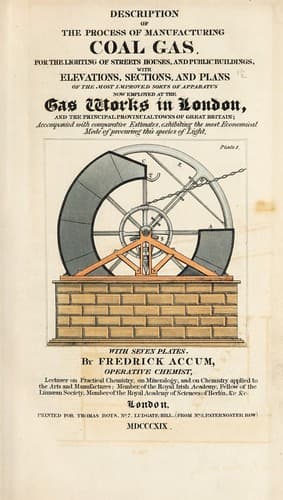
Description of the Process of Manufacturing Coal Gas, for the Lighting of Streets Houses, and Public Buildings: With Elevations, Sections, and Plans of the Most Improved Sorts of Apparatus Now Employed at the Gas Works in London and the Principal Provincial Towns of Great Britain; Accompanied With Comparative Estimates, Exhibiting the Most Economical Mode of Procuring This Species of LightAccum, Friedrich Christian
History
Description of the Process of Manufacturing Coal Gas, for the Lighting of Streets Houses, and Public Buildings: With Elevations, Sections, and Plans of the Most Improved Sorts of Apparatus Now Employed at the Gas Works in London and the Principal Provincial Towns of Great Britain; Accompanied With Comparative Estimates, Exhibiting the Most Economical Mode of Procuring This Species of Light
Accum, Friedrich Christian
Gas manufacture and works -- Great Britain; Gas-lighting
Cannel coal, deserves to be placed at the head of this class; next to
this, we may rank all those descriptions of coal known in the London
market by the names of Hartley, Cowper’s Main, Tanfield Moor, Eighton
Main, Blythe, and Pont Tops. It also includes the sort of coals found in
several parts of Scotland, called Splent coal, and some of those raised
on the Western Coast of England.
Most of the coals raised in Staffordshire ought likewise to be classed
among this species of coal, but the line of distinction between these,
and the classes subsequently named, cannot be accurately drawn.
The following table exhibits the maximum quantity of gas obtainable from
the first class of coal.[4]
[4] Own Experiments, made at the Royal Mint Gas-Works.
One Chaldron of Coal, produces Cubic feet of Gas.
Scotch Cannel coal 19,890
Lancashire Wiggan coal 19,608
Yorkshire Cannel coal,
(Wakefield) 18,860
Staffordshire coal,[5]
First variety,[6] 9,748
Second variety, 10,223
Third variety, 10,866
Fourth variety, 9,796
Gloucestershire coal,[7]
First variety, (Forest of Dean, High Delph) 16,584
Second variety, (Low Delph) 12,852
Third variety, (Middle Delph) 12,096
Newcastle coal,
First variety, (Hartley) 16,120
Second variety, (Cowper’s High Main) 15,876
Third variety, (Tanfield Moor) 16,920
Fourth variety, (Pontops) 15,112
[5] They require a much higher temperature, than is necessary for the
decomposition of Newcastle coal.
[6] For the maximum quantity of gas produced from this and the three
succeeding varieties of coal, I am indebted to J. Gostling, Esq.
Proprietor of the Birmingham Gas Works.
[7] Most varieties afford a porous, and very friable coke.
The second class of coal, comprehends all those varieties which contain
a less quantity of bitumen, and a larger quantity of carbon than the
first class. They burn with a flame less bright and of a more yellowish
colour, and the last portion of flame they are capable of yielding is
always of a lambent blue colour, they become soft after having laid on
the fire for some time, swell in bubbles and pass into a state of
semi-fusion, they then cohere and coke, puff up and throw out tubercular
scoriæ, with a hissing noise, accompanied with small jets of flame.
In consequence of the agglutination and tumefaction, the passage of air,
if this sort of coal be burnt in an open grate, is interrupted, the fire
burns as it is called hollow, and would become extinguished if the top
of the coal were not from time to time broken into with the poker.
Reviews
Reviews
No reviews yet
Be the first to share your thoughts on this work.
Join the Discussion
Join the discussion
Sign in to leave a comment or review.
Sign InorCreate an account