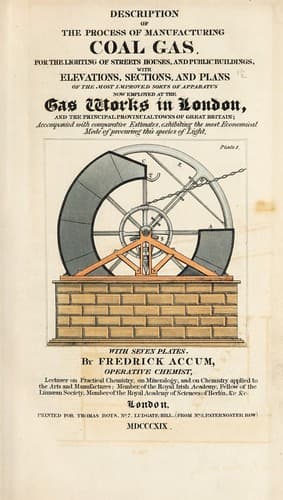
Description of the Process of Manufacturing Coal Gas, for the Lighting of Streets Houses, and Public Buildings: With Elevations, Sections, and Plans of the Most Improved Sorts of Apparatus Now Employed at the Gas Works in London and the Principal Provincial Towns of Great Britain; Accompanied With Comparative Estimates, Exhibiting the Most Economical Mode of Procuring This Species of LightAccum, Friedrich Christian
History
Description of the Process of Manufacturing Coal Gas, for the Lighting of Streets Houses, and Public Buildings: With Elevations, Sections, and Plans of the Most Improved Sorts of Apparatus Now Employed at the Gas Works in London and the Principal Provincial Towns of Great Britain; Accompanied With Comparative Estimates, Exhibiting the Most Economical Mode of Procuring This Species of Light
Accum, Friedrich Christian
Gas manufacture and works -- Great Britain; Gas-lighting
The coke formed from this species of coal is more compact than that
produced from the first sort of coal, and is well calculated for
standing the blast of bellows in metallurgical operations. In respect to
weight the second class of coal is considerably heavier than those of
the first class, the difference amounts to not less than from
twenty-eight pounds to thirty-three pounds in the sack of coal. A
chaldron of some varieties of this class of coal, if the coals are in
large lumps, weighs upwards of twenty-eight hundred weight.
The usual denomination by which the second class of coal is known in the
London market, is that of _strong burning coal_. The following varieties
are sufficiently known, Russel’s Walls-End; Bewick’s and Craister’s
Walls-End; Brown Walls-End, Wellington Main, Temple Main, Heaton Main,
Killingsworth Main, Percy Main, Benton Main, and some varieties of the
Swansea coal.
The smaller kinds of coal of this class are preferred by smiths, because
they stand the blast well. They make a caking fire so as to form a kind
of hollow, space or oven, as the workmen call it. Some varieties abound
in pyrites, and others are intersected with thin layers of slate and
lime-stone. They require more heat for being carbonized than the first
class, and the fluid obtained from it by distillation, contains a
considerable portion of carbonate, sulphate, and hydrosulphuret of
ammonia. They are well calculated for the production of coal gas; the
coke which they produce is not very brittle, and will bear moving from
place to place, without crumbling into dust.
The following table exhibits the maximum quantity of gas obtainable from
the second class of coal.[8]
[8] Own Experiments, made at the Royal Mint Gas-Works.
One Chaldron of Coal, produces Cubic feet of Gas.
Newcastle coal,
First variety, (Russel’s Wall’s End) 16,876
Second variety, (Bewick and Craister’s Wall’s End) 16,897
Third variety, (Heaton Main) 15,876
Fourth variety, (Killingsworth Main) 15,312
Fifth variety, (Benton Main) 14,812
Sixth variety, (Brown’s Wall’s End) 13,600
Seventh variety, (Mannor Main) 12,548
Eighth variety, (Bleyth) 12,096
Ninth variety, (Burdon Main) 13,608
Tenth variety, (Wears Wall’s End) 14,112
Eleventh variety, (Eden Main) 9,600
Twelfth variety, (Primrose Main) 8,348
Reviews
Reviews
No reviews yet
Be the first to share your thoughts on this work.
Join the Discussion
Join the discussion
Sign in to leave a comment or review.
Sign InorCreate an account