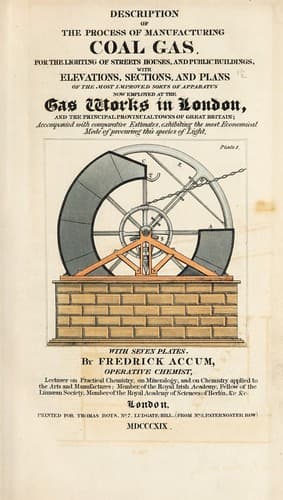
Description of the Process of Manufacturing Coal Gas, for the Lighting of Streets Houses, and Public Buildings: With Elevations, Sections, and Plans of the Most Improved Sorts of Apparatus Now Employed at the Gas Works in London and the Principal Provincial Towns of Great Britain; Accompanied With Comparative Estimates, Exhibiting the Most Economical Mode of Procuring This Species of Light — John Shaqi
Description of the Process of Manufacturing Coal Gas, for the Lighting of Streets Houses, and Public Buildings: With Elevations, Sections, and Plans of the Most Improved Sorts of Apparatus Now Employed at the Gas Works in London and the Principal Provincial Towns of Great Britain; Accompanied With Comparative Estimates, Exhibiting the Most Economical Mode of Procuring This Species of LightAccum, Friedrich Christian
History
Description of the Process of Manufacturing Coal Gas, for the Lighting of Streets Houses, and Public Buildings: With Elevations, Sections, and Plans of the Most Improved Sorts of Apparatus Now Employed at the Gas Works in London and the Principal Provincial Towns of Great Britain; Accompanied With Comparative Estimates, Exhibiting the Most Economical Mode of Procuring This Species of Light
Accum, Friedrich Christian
Gas manufacture and works -- Great Britain; Gas-lighting
The third and last class of coals includes those which are destitute of
bitumen, being chiefly composed of carbon in a peculiar state of
aggregation, evidently combined chemically with much earthy matter.
Coals of this class require a still higher temperature to become ignited
than any of the former classes, they emit little or no smoke. When laid
on a fire they burn away with a feeble lambent flame, indeed some
varieties give no flame at all, but burn merely with a red glow,
somewhat like charcoal, and at length become consumed without caking.
They leave a small portion of heavy ashes.
When submitted to distillation they afford little or no tar; of a
consistence almost resembling pitch, and a gaseous fluid chiefly
composed of gaseous oxide carbon and hydrogen gas. It is scarcely
necessary to add that they are altogether unfit to be employed for the
manufacture of coal gas. The Kilkenny, Welch, and stone or hard coal
belong to this class. They require a strong draught when burnt in an
open fire-grate, and the large quantity of gaseous oxide of carbon which
they furnish during their combustion is extremely offensive. This is
particularly the case with Kilkenny coal. The Welch stone or hard coal
is better adapted for culinary purposes, and there is reason to believe
that this species of coal might be rendered useful in the smelting of
iron ore, by a slight modification in the metallurgic process employed
for extracting the metal from its ore, but to eradicate prejudice, and
to alter established practices is a work which nothing but time can
effect. This species of coal is sent all over the kingdom; it is well
calculated for the operations of drying malt and hops, and its small
coal or culm has been found a more economical fuel, than Newcastle and
Sunderland coals, for the burning of lime and bricks, and for all other
processes where no blazing fuel is required.
The following table exhibits the maximum quantity of gas obtainable from
this class of coals.
One Chaldron of Coal, produces Cubic feet of Gas.
Welch coal. First variety, from
Tramsaren, near Kidwelly,[9] 2,116
Second variety, from the yard vein at the same place 1,656
Third variety, from Blenew, near Llandillo 1,416
Fourth variety, from Rhos, near Ponty Barren 1,272
Fifth variety, from the Vale of Gwendrath 1,292
Sixth variety, from ditto 1,486
[9] The coal for these Experiments was supplied gratuitously, to the
Gas Works of the Royal Mint, by Sir W. Paxton of Middleton Hall.
Reviews
Reviews
No reviews yet
Be the first to share your thoughts on this work.
Join the Discussion
Join the discussion
Sign in to leave a comment or review.
Sign InorCreate an account