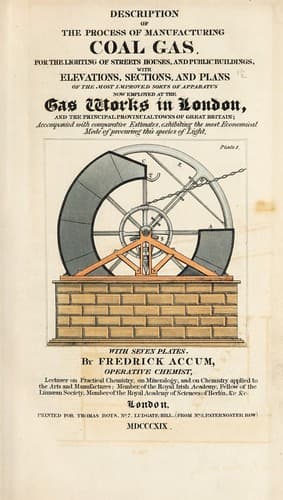
Description of the Process of Manufacturing Coal Gas, for the Lighting of Streets Houses, and Public Buildings: With Elevations, Sections, and Plans of the Most Improved Sorts of Apparatus Now Employed at the Gas Works in London and the Principal Provincial Towns of Great Britain; Accompanied With Comparative Estimates, Exhibiting the Most Economical Mode of Procuring This Species of Light — John Shaqi
Description of the Process of Manufacturing Coal Gas, for the Lighting of Streets Houses, and Public Buildings: With Elevations, Sections, and Plans of the Most Improved Sorts of Apparatus Now Employed at the Gas Works in London and the Principal Provincial Towns of Great Britain; Accompanied With Comparative Estimates, Exhibiting the Most Economical Mode of Procuring This Species of LightAccum, Friedrich Christian
History
Description of the Process of Manufacturing Coal Gas, for the Lighting of Streets Houses, and Public Buildings: With Elevations, Sections, and Plans of the Most Improved Sorts of Apparatus Now Employed at the Gas Works in London and the Principal Provincial Towns of Great Britain; Accompanied With Comparative Estimates, Exhibiting the Most Economical Mode of Procuring This Species of Light
Accum, Friedrich Christian
Gas manufacture and works -- Great Britain; Gas-lighting
Again at other establishments semi-cylindrical retorts, placed
horizontally upon their flat surfaces were employed; fig. 18. pl. V. The
length of these retorts was from five to six feet, and their vertical
and horizontal diameters were to each other as 6 inches, to 18 inches.
And at a few establishments, ellipsoidal retorts, fig. 17, plate V. were
used; these measured from five feet and a half, to six feet in length,
their major and minor axes bore different proportions to each other at
different establishments. At the first adoption of these retorts, the
proportions varied but little from the cylinder, but subsequently the
difference between the major and minor axes became gradually increased
till at last the major axis has become to the minor axis, as 20 to 10
inches, and at some gas works the proportions are as 25 to 10 inches.
With vessels of these forms the distillatory process was carried on for
some years, and the quantity of fuel employed to decompose a given
quantity of coal by means of them, amounted to from thirty to
thirty-six per cent.
When the dimensions of the retorts were increased, both the quantity of
fuel and time required for the decomposition of a given quantity of coal
was in a far greater ratio; and the operations of charging and
discharging the retorts, very troublesome.
Retorts of smaller dimensions have likewise been tried, but the more
frequent charging and discharging, which they require, occasioned such a
waste of time and labour, and such intermissions, in the temperature
necessary for the process of distillation, (besides being attended with
other disadvantages which will be afterwards explained), that they were
speedily discontinued at the gas works where they had been adopted.
The use of conical retorts, as well as of those of a semi-cylindrical
and parallelopipedal form, has of late been discontinued in most
establishments. The conical shape not only diminishes the capacity of
the vessel, but also renders it incapable of being heated economically.
From two comparative series of operations made on a large scale, and
continued for upwards of six months with conical and cylindrical
retorts, with a view to determine the comparative power of these
vessels, it has been proved that the same quantity of gas which can be
obtained by means of forty conical retorts, may be procured in the same
time and with the same quantity of coal and fuel, by means of
thirty-four cylindrical retorts.[10]
[10] These Experiments were made at the commencement of the new art of
lighting with gas, at the Westminster Chartered Gas Works, by Messrs.
Grant and Hargraves.
Reviews
Reviews
No reviews yet
Be the first to share your thoughts on this work.
Join the Discussion
Join the discussion
Sign in to leave a comment or review.
Sign InorCreate an account