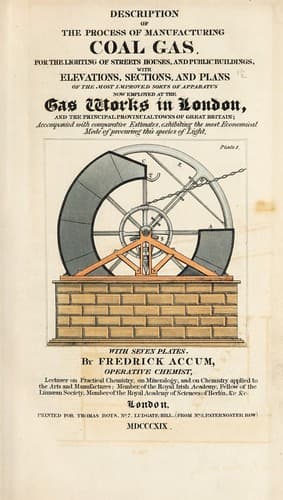
Description of the Process of Manufacturing Coal Gas, for the Lighting of Streets Houses, and Public Buildings: With Elevations, Sections, and Plans of the Most Improved Sorts of Apparatus Now Employed at the Gas Works in London and the Principal Provincial Towns of Great Britain; Accompanied With Comparative Estimates, Exhibiting the Most Economical Mode of Procuring This Species of LightAccum, Friedrich Christian
History
Description of the Process of Manufacturing Coal Gas, for the Lighting of Streets Houses, and Public Buildings: With Elevations, Sections, and Plans of the Most Improved Sorts of Apparatus Now Employed at the Gas Works in London and the Principal Provincial Towns of Great Britain; Accompanied With Comparative Estimates, Exhibiting the Most Economical Mode of Procuring This Species of Light
Accum, Friedrich Christian
Gas manufacture and works -- Great Britain; Gas-lighting
Similar experiments have been undertaken, to determine the comparative
action of semi-cylindrical and parallelopipedal retorts.[11] The latter,
when kept in action day and night, do not long retain their shape; their
sides collapse, their capacity becomes diminished, their angular form
causes the heat to act upon them unequally, in whatever manner it may be
applied, in consequence of which they suffer more deterioration in some
parts than in others. Besides, they require a much larger proportion of
fuel for decomposing a certain quantity of coal than the cylindrical
retorts.
[11] At the Birmingham Gas Works.
Semi-cylindrical retorts, with the base of the retort bent inwards, so
as to give the vessel a kidney-shaped form, have likewise been tried.
But this shape is still less advantageous; they could not be made to
work uniform, they required more heat, and their deterioration was more
rapid than cylindrical retorts. They could not be kept fit for use when
worked day and night, more than about five months. And with regard to
ellipsoidal retorts, it must be confessed, that the experiments that
have as yet been made upon a large scale to ascertain their powers, are
not of a nature to enable us to decide on their merits. No experiments
have been carried on with retorts of this description in the metropolis
for a sufficient length of time, with that care and attention which the
subject demands, to ascertain their comparative power. From what however
has been done, there is reason to believe that ellipsoidal retorts,
might be found more advantageous, than those of a cylindrical form now
in use. An ellipsoidal retort, 20 inches by 10 in diameter, and six feet
long, weighs 14 Cwt.
The reader will thus observe, that of all the forms of retorts which
have been hitherto fairly tried, upon a large scale, it has been
satisfactorily ascertained, (excepting only as to the ellipsoidal
retorts), that the cylinder is the best form for decomposing coal in
masses, from five to eight or ten inches in thickness.
It is perhaps needless to state that in making experiments on the
comparative value of the best form of cast-iron retorts, it is obvious
that the operations should be continued for some months uninterruptedly;
no conclusion can be drawn that may become practically useful in the
large way, from processes carried on for a few weeks only. It is
absolutely essential that the comparative trials be continued for months
together, and that the inferences be taken from the total quantity of
coal used during that period, compared with the total quantity of gas
obtained, the deterioration of the retorts, and the time and labour
expended.
Reviews
Reviews
No reviews yet
Be the first to share your thoughts on this work.
Join the Discussion
Join the discussion
Sign in to leave a comment or review.
Sign InorCreate an account