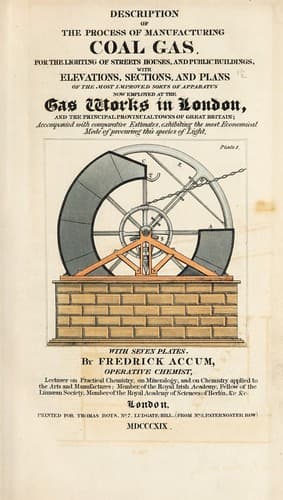
Description of the Process of Manufacturing Coal Gas, for the Lighting of Streets Houses, and Public Buildings: With Elevations, Sections, and Plans of the Most Improved Sorts of Apparatus Now Employed at the Gas Works in London and the Principal Provincial Towns of Great Britain; Accompanied With Comparative Estimates, Exhibiting the Most Economical Mode of Procuring This Species of LightAccum, Friedrich Christian
History
Description of the Process of Manufacturing Coal Gas, for the Lighting of Streets Houses, and Public Buildings: With Elevations, Sections, and Plans of the Most Improved Sorts of Apparatus Now Employed at the Gas Works in London and the Principal Provincial Towns of Great Britain; Accompanied With Comparative Estimates, Exhibiting the Most Economical Mode of Procuring This Species of Light
Accum, Friedrich Christian
Gas manufacture and works -- Great Britain; Gas-lighting
Proceeding on erroneous data, many have persuaded themselves of having
noticed that parallelopipedal and semi-cylindrical retorts last longer
fit for use than those of a cylindrical shape, an assertion of which
subsequent trials, conducted in the manner just stated, has clearly
shown the fallacy. Enough has been done at the different gas works in
the capital to settle this point, and there is now but one opinion
amongst those who are best qualified to judge of the subject. Every body
who has made the trial on a large scale, is convinced as already stated,
that the best form of the retort for manufacturing coal gas where the
process is conducted on the plan of decomposing coal in masses or layers
of from four to eight inches in thickness, is a cylinder six and a half
feet long, and one foot in diameter, and accordingly retorts of this
shape and dimensions are now used in all the best regulated gas
establishments in the metropolis.
A cylindrical retort of the description before named, weighs about nine
and a half to ten hundred weight. These and all other shaped retorts are
furnished with a moveable lid or cover having a conical edge to fit the
mouth-piece; the cover is rendered air-tight, not as formerly by
grinding, a mode which was costly, but by the interposition of a thin
coat of loom, between the lid and the mouth of the retort.
The mouth-piece forms a separate part of the retort. It is bolted and
screwed to a flanch which terminates the mouth of the retort, so that
when the retort is worn out, the mouth-piece may be detached and applied
to new retorts.
There are now in action 620 cylindrical retorts, at the two chartered
Gas Works[12] in the metropolis; and the total number of retorts at all
the London gas establishments amounts to 960.
[12]
{ Westminster Station 250 Retorts.
Westminster Gas Works, { Brick Lane ditto 190 ditto
{ Norton Falgate ditto 50 ditto
City of London Gas Works, Dorset Street, 130 ditto
---
620
_Application of heat.--Flue Plan originally adopted._
It must be obvious that the durability of the distillatory apparatus,
greatly depends on the manner in which the heat is applied, to effect
the decomposition of the coal contained within the retort. If the heat
be very intense the whole vessel is rapidly destroyed. If it be too
languid, the distillatory process is protracted, and much fuel, time,
and labour wasted to no purpose; and the retort is speedily
deteriorated, if the heat acts upon one part of it more than upon
another.
Reviews
Reviews
No reviews yet
Be the first to share your thoughts on this work.
Join the Discussion
Join the discussion
Sign in to leave a comment or review.
Sign InorCreate an account