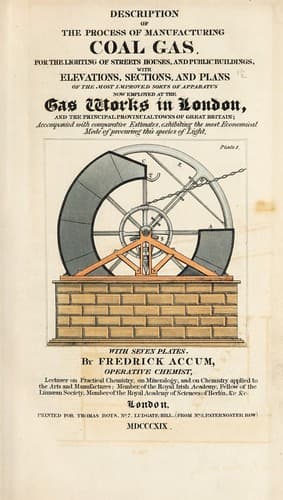
Description of the Process of Manufacturing Coal Gas, for the Lighting of Streets Houses, and Public Buildings: With Elevations, Sections, and Plans of the Most Improved Sorts of Apparatus Now Employed at the Gas Works in London and the Principal Provincial Towns of Great Britain; Accompanied With Comparative Estimates, Exhibiting the Most Economical Mode of Procuring This Species of Light — John Shaqi
Description of the Process of Manufacturing Coal Gas, for the Lighting of Streets Houses, and Public Buildings: With Elevations, Sections, and Plans of the Most Improved Sorts of Apparatus Now Employed at the Gas Works in London and the Principal Provincial Towns of Great Britain; Accompanied With Comparative Estimates, Exhibiting the Most Economical Mode of Procuring This Species of LightAccum, Friedrich Christian
History
Description of the Process of Manufacturing Coal Gas, for the Lighting of Streets Houses, and Public Buildings: With Elevations, Sections, and Plans of the Most Improved Sorts of Apparatus Now Employed at the Gas Works in London and the Principal Provincial Towns of Great Britain; Accompanied With Comparative Estimates, Exhibiting the Most Economical Mode of Procuring This Species of Light
Accum, Friedrich Christian
Gas manufacture and works -- Great Britain; Gas-lighting
The apparently conclusive results of these experiments did not, however,
prevent another set of experiments from being made on the same
principle, extended even a degree farther. The problem now proposed to
be solved, was, whether four retorts might not be heated with economy,
in a manner which had been found already wasteful with respect to three,
that is, whether four instead of two retorts might not be heated
economically by means of one fire-place.
On this plan one hundred and sixteen cylindrical retorts of the usual
dimensions were again erected at the Westminster gas establishment, and
sixty-four at another station belonging to the same chartered company.
These retorts were kept in action in the best possible manner night and
day, and the results, as might have been anticipated, only served to
confirm the facts already established by experiment with three retorts.
Nothing was found to be gained; and so far from their being any saving
in respect of fuel and wear and tear of the retorts, the waste beyond
that which takes place on the plan of two retorts to one fire-place,
was increased to nearly twenty-five per cent., accompanied by a
corresponding acceleration of injury to the retorts.
It was still imagined, however, that the great waste of fuel and the
ultimate unfavourable result of these proceedings, which were repeated
with as little success at several other gas-works in the metropolis with
parallelopipedal retorts, and at other works with retorts of a
semi-cylindrical form, set in a way different from that pursued at the
Westminster station, might probably have been owing to the unavoidable
circumstance, that the heat was not made to act upon all the retorts
employed uniformly in each series of four retorts, but in a manner so
variable that one, or even two of the series would become destroyed and
rendered useless, while the others continued uninjured in a sound and
working state.
The excessive waste of fuel was occasioned, we are told, by the number
of injured retorts, which became useless, and were nevertheless required
to be kept red hot to no purpose; for it was actually found that when
one retort of a series of four became injured, the same fire which had
heated the whole four, still required to be kept up to maintain in
action the remaining three of the series, and so on with respect to the
whole range, till ultimately when there might remain only eighty retorts
actually in use, as many fire-places were required to be in full action
as would have been sufficient to serve for one hundred retorts.
Reviews
Reviews
No reviews yet
Be the first to share your thoughts on this work.
Join the Discussion
Join the discussion
Sign in to leave a comment or review.
Sign InorCreate an account