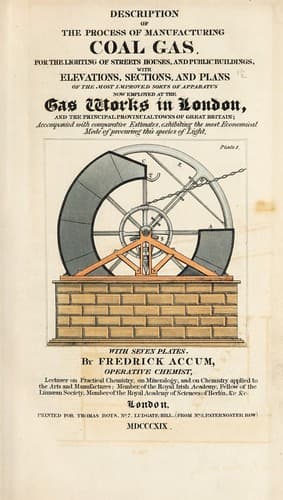
Description of the Process of Manufacturing Coal Gas, for the Lighting of Streets Houses, and Public Buildings: With Elevations, Sections, and Plans of the Most Improved Sorts of Apparatus Now Employed at the Gas Works in London and the Principal Provincial Towns of Great Britain; Accompanied With Comparative Estimates, Exhibiting the Most Economical Mode of Procuring This Species of Light — John Shaqi
Description of the Process of Manufacturing Coal Gas, for the Lighting of Streets Houses, and Public Buildings: With Elevations, Sections, and Plans of the Most Improved Sorts of Apparatus Now Employed at the Gas Works in London and the Principal Provincial Towns of Great Britain; Accompanied With Comparative Estimates, Exhibiting the Most Economical Mode of Procuring This Species of LightAccum, Friedrich Christian
History
Description of the Process of Manufacturing Coal Gas, for the Lighting of Streets Houses, and Public Buildings: With Elevations, Sections, and Plans of the Most Improved Sorts of Apparatus Now Employed at the Gas Works in London and the Principal Provincial Towns of Great Britain; Accompanied With Comparative Estimates, Exhibiting the Most Economical Mode of Procuring This Species of Light
Accum, Friedrich Christian
Gas manufacture and works -- Great Britain; Gas-lighting
Attempts accordingly were now made to get over this supposed cause of
the losing results, already obtained from the plan of four retorts to
one fire-place, by a new series of similar operations, in which the
retorts were fixed in such a manner, that those which happened to become
injured during the process, might easily and immediately be withdrawn
without materially disturbing the rest, and replaced by new ones. The
waste of fuel was, it is clear, greatly lessened by the expedient; yet
still upon the whole there was no such variation from the general
results obtained by the preceding experiments, as to justify the
adoption of this plan of increasing the number of retorts worked by one
fire-place, on any principle of sound economy.
The great obstacle, as the reader will at once perceive, to working more
than two retorts, no matter whether cylindrical, or of any of the other
forms before named, with economy, by means of one fire-place, evidently
arose from the difficulty of conducting the heat by means of flues
around the series of retorts, in such a manner that the heat shall act
with equal force on all the retorts.
It is almost needless to state, that the construction of the
fire-places, and the direction of the flues for applying the heat to the
retorts, were varied by different workmen, who prided themselves on
being able to aid the object in view, but the result always showed even
that when the draft of the fire-place was well obtained, the action of
the heat upon the series of retorts could not be distributed equally and
kept up uniformly, except at a great expence of fuel and vast
deterioration of the distillatory vessels. The retorts always became
injured more in some parts than in others. The concentration and
rapidity of the draught of the fire, beyond a certain velocity was
always found highly injurious to the retort, and this observation has
been since amply confirmed.
In a well constructed furnace, the deterioration of all the retorts in
the series is uniform over the whole vessel; no part of the retort is
_burnt out_, as the workmen call it, sooner than another part; and
whenever the contrary happens, we may pronounce the fire to be badly
applied. When there is such misapplication of the heat, the manufacturer
cannot depend upon the duration of the distillatory vessel; he is always
in a state of uncertainty with regard to their wear and tear, and it not
unfrequently has happened, under such circumstances, that a whole series
of retorts have become suddenly deteriorated.
_Oven plan lately adopted._
Reviews
Reviews
No reviews yet
Be the first to share your thoughts on this work.
Join the Discussion
Join the discussion
Sign in to leave a comment or review.
Sign InorCreate an account