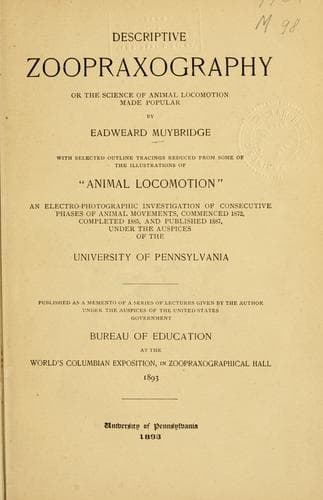
Descriptive Zoopraxography; or, the science of animal locomotion made popularMuybridge, Eadweard
Science
Descriptive Zoopraxography; or, the science of animal locomotion made popular
Muybridge, Eadweard
Animal locomotion
For the purpose of determining the synchronous action of the
electro-exposors while making a double series of exposures, the accuracy of
the time intervals as recorded by the chronograph, and the duration of the
shortest photographic exposures used in the investigation, the two
batteries of portable cameras were placed side by side, and the exposors
were each connected with the exposing motor by separate lengths of a
hundred feet of cable. The two series of cameras were pointed to a rapidly
revolving disc of five feet diameter. The surface of the disc was black,
with narrow white lines radiating from the center to the edge like the
spokes of a wheel. A microscopic examination of the two series of resulting
negatives proved that no variation could be discovered in the synchronous
action of ten of the duplicated series of exposures, and that in the
remaining two a variation existed in the simultaneity of a few
ten-thousandths of a second--a result sufficiently near to simultaneity for
all ordinary photographic work.
[Illustration: Fig. 9.]
A reproduction of the chronographic record of one of these experiments is
seen in figure 9.
The first line records the revolution of the disc; the second the vibration
of the tuning fork; and each group of three long double markings in the
third line indicates a photographic exposure.
The shortest exposures made at the University were--approximately--the one
six-thousandth part of a second; such brief exposures are however for this
class of investigation very rarely needed.
Some horses galloping at full speed will, for a short distance, cover about
fifty-six or fifty-eight feet of ground in a second of time; a full mile
averaging perhaps a hundred seconds. At this speed, a foot recovering its
loss of motion will be thrust forward with an occasional velocity of at
least 120 lineal feet in a second of time.
During the one one-thousandth part of a second the body of the horse will
at this rate move forward about seven one-tenths of an inch, and a moving
foot perhaps one and a half inches, not a very serious matter for the usual
requirements of the amateur photographer.
A knowledge of the duration of the exposures, however, was in this
investigation of no value, and scarcely a matter of curiosity, the aim
always being to give as long an exposure as the rapidity of the action
would permit, with a due regard to the necessary sharpness of outline, and
essential distinctness of detail.
The power used for operating the magnets, through the exposing motor, was
given from a lé Clanché battery of fifty-four cells, arranged in multiple
arc of three series, each of eighteen cells.
During the investigation at the University of Pennsylvania, more than a
hundred thousand photographic exposures were made.
Public-domain text, read in full here on John Shaqi.
Reviews
Reviews
No reviews yet
Be the first to share your thoughts on this work.
Join the Discussion
Join the discussion
Sign in to leave a comment or review.
Sign InorCreate an account