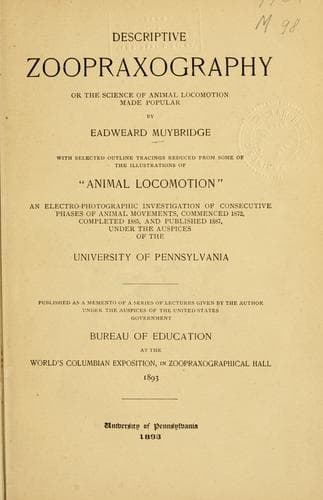
Descriptive Zoopraxography; or, the science of animal locomotion made popularMuybridge, Eadweard
Science
Descriptive Zoopraxography; or, the science of animal locomotion made popular
Muybridge, Eadweard
Animal locomotion
The negative plates were supplied by the Cramer Dry Plate Company of St.
Louis, and the positive plates by the Carbutt Company of Philadelphia. On a
favorable day five hundred or six hundred negatives were sometimes exposed;
on one day the number of exposures reached seven hundred and fifty.
The electrical manipulations were directed by Lino F. Rondinella; the
development room was in charge of Henry Bell. The author takes pleasure in
acknowledging the skill, patience and energy which these gentlemen
exhibited in their respective fields of labor.
Although the one six-thousandth part of a second was the duration of the
most rapid exposure made in this investigation, it is by no means the limit
of mechanically effected photographic exposures, nor does the one-sixtieth
part of a second approach the limit of time intervals. Marey, in his
remarkable physiological investigations, has recently made successive
exposures with far less intervals of time; and the author has devised, and
when a relaxation of the demands upon his time permit, will use an
apparatus which will photograph twenty consecutive phases of a single
vibration of the wing of an insect; even assuming as correct a quotation
from _Nicholson's Journal_ by Pettigrew in his work on Animal Locomotion
that a common house fly will make during flight seven hundred and fifty
vibrations of its wings in a second of time, a number probably far in
excess of the reality.
The ingenious gentlemen who are persistently endeavoring to overcome the
obstacles in the construction of an apparatus for aerial navigation, will
perhaps some day be awakened by the fact that the only successful method of
propulsion will be found in the action of the wing of an insect.
We will now resume the subject proper of this monograph.
It is impossible within its limits to trace the history of the art of
delineating animals in motion, or to illustrate it with examples of the
truthful impressions of the primitive Artists, or of the imaginative and
erroneous conceptions of many of those of modern times. Certain phases of
the facts of Animal Locomotion will alone be treated upon, as demonstrated
by photographic research.
The illustrations and condensed definitions of the various gaits were
prepared by the Author for the "Standard Dictionary." Before studying these
it is essential that the meaning of the terms _step_ and _stride_ should be
distinctly understood.
A STEP is an act of progressive animal motion, in which one of the
supporting members of the body is thrust in the direction of the motion and
the support transferred, wholly, or in part, from one member to another.
Public-domain text, read in full here on John Shaqi.
Reviews
Reviews
No reviews yet
Be the first to share your thoughts on this work.
Join the Discussion
Join the discussion
Sign in to leave a comment or review.
Sign InorCreate an account