Descriptive Zoopraxography; or, the science of animal locomotion made popular — John Shaqi
Descriptive Zoopraxography; or, the science of animal locomotion made popularMuybridge, Eadweard
Science
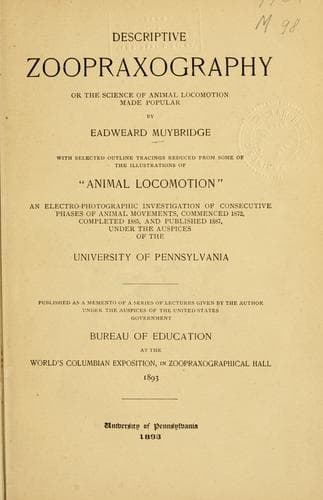
Descriptive Zoopraxography; or, the science of animal locomotion made popular
Muybridge, Eadweard
Animal locomotion
The right hind foot strikes the ground and shares the weight of the body.
The left hind foot leaves the ground while the right hind pastern is in its
horizontal phase, supporting all the weight. At this period the left fore
leg is perfectly straight, with the toe much higher than the heel, and is
thrust forward until the pastern joint is vertical with the nose, the right
fore knee is bent at a right angle. The left fore foot now strikes and
these diagonals are for a brief period upon the ground together. The left
fore leg, however, immediately assumes the entire responsibility of support
and attains a vertical position, with the pastern at a right angle. The
right fore leg becomes perfectly rigid, and is thrust forward to its
fullest extent. The right fore foot now strikes the ground, the two fore
legs form a right angle, and the hind feet are found thrust backward, the
right to its fullest extent. The left fore leg having completed its
functions of support, is now lifted, and the weight transferred to the
right fore foot alone, which is soon found behind the centre of gravity;
the left hind foot passes to the front of the right fore leg, which,
exercising its final act of propulsion, thrusts the horse through the air;
the left hind foot descends; the stride is completed, and the consecutive
phases are renewed. From this analysis we learn that if the spring is made
from the right fore foot during the rapid gallop of a thoroughbred horse,
it is supported consecutively by
The left hind foot.
Both hind feet.
The right hind foot.
The right hind and the left fore feet.
The left fore foot.
Both fore feet.
The right fore foot.
From which he springs into the air to re-commence the phases with the left
hind foot, while the only phase in which he has been discovered without
support is one when the legs are flexed under the body. All of the feet at
this time are nearly close together and have comparatively little
independent motion; this phase, therefore, more persistently than any
other, forces itself upon the attention of the careful observer, and
conveys to him the impression of a horse's rapid motion in singular
contradiction to the conventional interpretation, until quite recently,
usually adopted by the Artist.
It should not be understood that the term "spring" implies that the body of
the horse is greatly elevated by that action; were it so, much force would
be unnecessarily expended with the result of loss of speed. The center of
gravity of a horse trotting or galloping at a high rate of speed will
preserve an almost strictly horizontal line, the undulations being very
slight.
In the gallop of the horse it is probable there may be sometimes a period
of suspension between the lifting of one fore foot and the descent of the
other, but it has not yet been demonstrated.
The method of galloping described applies to the horse and its allies, and
to most of the cloven and soft-footed animals.
Public-domain text, read in full here on John Shaqi.
Reviews
Reviews
No reviews yet
Be the first to share your thoughts on this work.
Join the Discussion
Join the discussion
Sign in to leave a comment or review.
Sign InorCreate an account