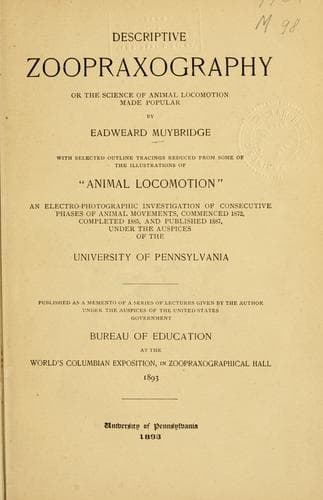
Descriptive Zoopraxography; or, the science of animal locomotion made popular — John Shaqi
Descriptive Zoopraxography; or, the science of animal locomotion made popularMuybridge, Eadweard
Science
Descriptive Zoopraxography; or, the science of animal locomotion made popular
Muybridge, Eadweard
Animal locomotion
In the gallop of the dog the sequence of foot falling and the action of the
body is materially different, and the animal is free from support twice in
each stride.
[Illustration: THE GALLOP OF THE DOG.]
Assuming that a racing hound after a flight through the air with elongated
body and extended legs (like the conventional galloping horse), lands upon
the left fore foot, the right fore will next touch the ground; from this he
will again spring into the air, and with curved body and flexed legs land
upon the right hind foot, while the right fore feet will be half the length
of the body to the rear. The left hind now descends, another flight is
effected, and again the left fore repeats its functions of support and
propulsion.
These successive foot fallings are common to all dogs when galloping, and
it is worthy of note that the same rotary action in the use of the limbs is
adopted in the gallop of the elk, the deer and the antelope, all of which
animals, like the dog, can for a time excel the horse in speed.
A search through all the dictionaries published at the time of writing, and
accessible to the Author, fails to discover a correct definition of "the
gallop." This motion is in America frequently miscalled the "run," and its
execution "running," but no corresponding explanation of the word is given
by any lexicographer.
In Scott's "Lady of the Lake" occurs "Then faint afar are heard the feet of
rushing steeds in _gallop_ fleet," many other distinguished Authors refer
to the same action by the same name, by which, or its equivalents, it is
universally known in Europe.
THE LEAP.
There is little essential difference in general characteristics of either
of the several movements that have been described, but with a number of
experiments made with horses while leaping, no two were found to agree in
the manner of execution. The leap of the same horse at the same rate of
speed, with the same rider, over the same hurdle, disclosed much variation
in the rise, clearance, and descent of the animal. A few phases were,
however, invariable. While the horse was raising his body to clear the
hurdle, one hind foot was always in advance of the other, which exercised
its last energy alone.
On the descent, the concussion was always first received by one fore foot,
followed more or less rapidly by the other, sometimes as much as 30 inches
in advance of where the first one struck; the hind feet were also landed
with intervals of time and distance.
No attempt will be made to analyze the consecutive phases of various other
acts of Animal Locomotion, such as rearing, bucking, kicking, tossing,
etc., on account of the irregularity which characterizes their execution,
and the difficulty of obtaining reliable data.
Public-domain text, read in full here on John Shaqi.
Reviews
Reviews
No reviews yet
Be the first to share your thoughts on this work.
Join the Discussion
Join the discussion
Sign in to leave a comment or review.
Sign InorCreate an account