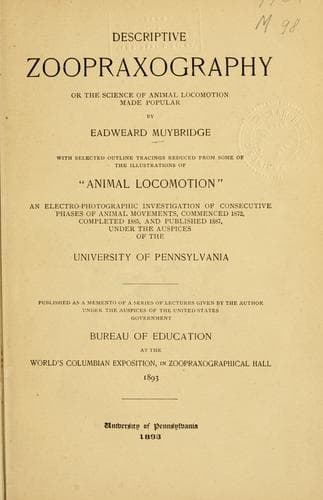
Descriptive Zoopraxography; or, the science of animal locomotion made popularMuybridge, Eadweard
Science
Descriptive Zoopraxography; or, the science of animal locomotion made popular
Muybridge, Eadweard
Animal locomotion
In the presentation of a Lecture on Zoöpraxography the course usually
adopted is to project, much larger than the size of life upon a screen, a
series of the most important phases of some act of animal motion--the
stride of a horse, while galloping for example--which are analytically
described. These successive phases are then combined in the Zoöpraxiscope,
which is set in motion, and a reproduction of the original movements of
life is distinctly visible to the audience.
With this apparatus, horse-races are reproduced with such fidelity that the
individual characteristics of the motion of every animal can readily be
seen; flocks of birds fly across the screen with every movement of their
wings clearly perceptible; two gladiators contend for victory with an
energy which would cause the arena to resound with wild applause, athletes
turn somersaults, and other actions by men, women and children, horses,
dogs, cats and wild animals, such as running, dancing, jumping, trotting
and kicking, are illustrated in the same manner. By this method of analysis
and synthesis the eye is taught how to observe and to distinguish the
differences between a true and a false impression of animal movements. The
Zoöpraxiscopical exhibition is followed by illuminated copies of paintings
and sculptures, demonstrating how the movement has been interpreted by the
Artists of all ages; from the primitive engravers of the cave dwelling
period, to the most eminent painters and sculptors of the present day.
* * * * *
INTRODUCTION.
In the year 1872, while the Author was engaged in his official duties as
Photographer of the United States Government for the Pacific coast, there
arose in the city of San Francisco one of those controversies upon Animal
Locomotion, which has engaged the attention of mankind from the dawn of
symbolical design, to the present era of reformation in the artistic
expression of animal movements.
The subject of this particular dispute was the possibility of a horse
having all of his feet free of contact with the ground at the same instant,
while trotting, even at a high rate of speed, and the disputants were Mr.
Frederick MacCrellish and the Hon. Leland Stanford.
The attention of the Author was directed to this controversy and he
immediately sought the means for its settlement.
At this time the rapid dry plate had not yet been evolved from the
laboratory of the chemist, and the problem before him was to develop a
sufficiently intense and contrasted image upon a wet collodion plate, after
an exposure of so brief a duration that a horse's foot moving with a
velocity of more than a hundred lineal feet in a second of time, should be
photographed practically "sharp."
Public-domain text, read in full here on John Shaqi.
Reviews
Reviews
No reviews yet
Be the first to share your thoughts on this work.
Join the Discussion
Join the discussion
Sign in to leave a comment or review.
Sign InorCreate an account