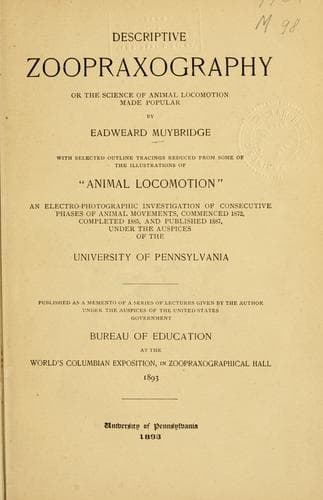
Descriptive Zoopraxography; or, the science of animal locomotion made popularMuybridge, Eadweard
Science
Descriptive Zoopraxography; or, the science of animal locomotion made popular
Muybridge, Eadweard
Animal locomotion
A few days' experimenting and about a dozen negatives, with a celebrated
fast trotter--"Occident"--as a model, while trotting at the rate of a mile
in two minutes and sixteen seconds, laterally in front of the camera,
decided the argument for once and for all time in favor of those disputants
who held the opinion that a horse while trotting was for a portion of his
stride entirely free from contact with the ground. With a knowledge of the
fact that some horses while trotting will make a stride of twenty feet or
more in length, it is difficult to understand why there should ever have
been any difference of opinion on the subject.
These first experiments of Zoöpraxography were made at Sacramento,
California, in May, 1872. A few impressions were printed from the selected
negative for private distribution, and were commented upon by the "Alta
California," a newspaper published in San Francisco.
Thus far the photographs had been made with a single camera, requiring a
separate trotting for each exposure. The horse being of a dark color and
the background white, the pictures were little better than silhouettes, and
it was difficult to distinguish, except by inference, the right feet from
the left.
Several phases of as many different movements had been photographed, which
the Author endeavored with little success to arrange in consecutive order
for the construction of a complete stride.
It then occurred to him that if a number of cameras were placed in a line,
and exposures effected successively in each, with regulated intervals of
time or of distance, an analysis of one single step or stride could be
obtained which would be of value both to the Scientist and the Artist.
The practical application of this system of photographing required
considerable time for its development, and much experimenting with
chemicals and apparatus.
It being desirable that the horses used as models should be representatives
of their various breeds, and the Author not being the owner of any that
could be fairly classed as such, obtained the coöperation of Mr. Stanford,
who owned a fine stud of horses at his farm at Palo Alto, and there
continued his labors.
The apparatus used at this stage of the investigation was essentially the
same as that subsequently constructed for the University of Pennsylvania,
the arrangement of which will be described further on.
Some of the results of these early experiments which illustrated successive
phases of the action of horses while walking, trotting, galloping, &c.,
were published in 1878, with the title of "The Horse in Motion." Copies of
these photographs were deposited the same year in the Library of Congress
at Washington, and some of them found their way to Berlin, London, Paris,
Vienna, &c., where they were criticized by the journals of the day.
Public-domain text, read in full here on John Shaqi.
Reviews
Reviews
No reviews yet
Be the first to share your thoughts on this work.
Join the Discussion
Join the discussion
Sign in to leave a comment or review.
Sign InorCreate an account