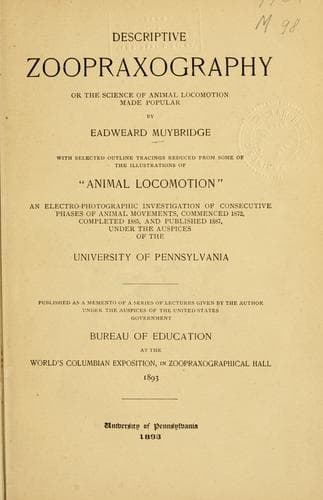
Descriptive Zoopraxography; or, the science of animal locomotion made popular — John Shaqi
Descriptive Zoopraxography; or, the science of animal locomotion made popularMuybridge, Eadweard
Science
Descriptive Zoopraxography; or, the science of animal locomotion made popular
Muybridge, Eadweard
Animal locomotion
In 1882 the Author visited Europe and at a reception given him by Monsieur
Meissonier was invited by that great painter to exhibit the results of his
labors to his brother Artists who had assembled in his studios for that
purpose. M. Meissonier was the first among Artists to acknowledge the value
to Art design of the Author's researches; and upon this occasion, alluding
to a full knowledge of the details of a subject being necessary for its
truthful and satisfactory translation by the Artist, he declared how much
his own impression of a horse's motion had been changed after a careful
study of its consecutive phases.
It is scarcely necessary to point out, in confirmation of M. Meissonier's
assertions, the modifications in the expression of animal movements now
progressing in the works of the Painter and the Sculptor, or to the fact of
their being the result of studious attention to the science of
Zoöpraxography.
In the same year, during a lecture on "The Science of Animal Locomotion in
Its Relation to Design in Art," given at the Royal Institution (see
_Proceedings_ of the Royal Institution of Great Britain, March 13, 1882),
the author exhibited the results of his experiments at Palo Alto, when he,
with the Zoöpraxiscope and an oxy-hydrogen lantern, projected on the wall a
synthesis of many of the actions he had photographed.
It may not be considered irrelevant if he repeats what he on that occasion
said in his analysis of the quadrupedal walk:--
"So far as the camera has revealed, these successive foot fallings are
invariable, and _are probably common to all quadrupeds_....
"It is also probable that these photographic investigations--which were
executed with wet collodion plates, with exposures not exceeding in some
instances the one five-thousandth part of a second--will dispel many
popular illusions as to the gaits of a horse, and future and more
exhaustive experiments, with the advantages of recent chemical discoveries,
will completely unveil all the visible muscular action of men and animals
even during their most rapid movements....
"The employment of automatic apparatus for the purpose of obtaining a
regulated succession of photographic exposures is too recent for it to be
generally used for scientific experiment or for its advantages to be
properly appreciated. At some future time the philosopher will find it
indispensable for many of his investigations."
Public-domain text, read in full here on John Shaqi.
Reviews
Reviews
No reviews yet
Be the first to share your thoughts on this work.
Join the Discussion
Join the discussion
Sign in to leave a comment or review.
Sign InorCreate an account