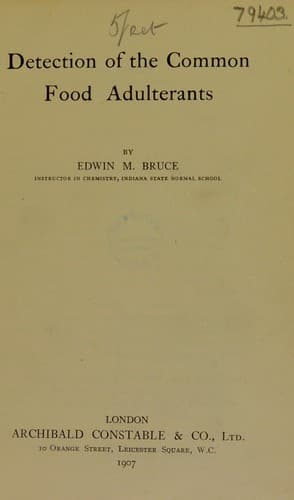
Detection of the Common Food Adulterants — John Shaqi
Detection of the Common Food AdulterantsBruce, Edwin M.
Science
Detection of the Common Food Adulterants
Bruce, Edwin M.
Food adulteration and inspection
Hold the egg between a bright light and the eye, and if the air chamber
is small, and no dark spots but instead a rather uniform rose-colored
tint is seen, the egg is fresh. If the contents appear cloudy and the
air chamber larger, the egg is not fresh. The darker the contents of the
egg the older it is.
CHAPTER III
CEREAL PRODUCTS
FLOUR
Sometimes a cheaper or inferior grade of flour is substituted for one of
higher quality, and even a different kind of flour may be substituted,
as corn meal in wheat flour, or wheat in rye flour. Alum may be added by
millers to cover up traces of bad flour, and by bakers to make the bread
white when a bad or cheap flour is being used. Copper sulfate also may
be added to improve the appearance. Occasionally rye flour is made from
rye upon which ergot has developed. Stannous chlorid and potassium
carbonate are added to ginger cake to give the same color to the product
made of molasses and a poor grade of flour as that made from good flour
and honey.
ALUM
_Wynther Blyth Method._--Add a little water to the sample and macerate.
Soak pieces of gelatin in the solution and leave for a half day, remove
the gelatin and dip the pieces in a mixture of equal volumes of a fresh
tincture of logwood and a saturated solution of ammonium carbonate. The
gelatin strips will turn blue if alum is present.
_Bell & Carter Method._--Make a fresh 5 per cent tincture of logwood in
methyl alcohol. Dampen about 10 grams of the flour with water and add 1
cc. of the logwood tincture and the same quantity of a saturated
solution of ammonium carbonate. Pure flour gives a pinkish color which
fades to buff or brown. The presence of alum produces a lavender or
bluish tint which becomes more distinct as it dries.
COPPER SULFATE
This adulterant may be detected in either flour or bread, by soaking the
flour or bread in a dilute solution of potassium ferrocyanid acidulated
with acetic acid. If copper be present a purplish or reddish-brown
coloration will be produced.
SUBSTITUTED FLOURS
_Vogel’s Method._--Make a mixture of alcohol (70 per cent), 95 parts,
hydrochloric acid 5 parts. Treat a sample of the flour in a test tube
with this reagent. Shake well. Heat to boiling and allow to settle. A
colorless fluid shows the flour to be pure, a straw-colored tint
indicates the presence of gruffs with bran, an orange-yellow proves the
presence of corn-cockle flour, a flesh-colored liquid indicates the
presence of ergot, while a green color indicates buckwheat flour.
CORN MEAL IN WHEAT FLOUR
_Kraemer claims to be able to detect as small amount as 5 per cent of
maize in wheat flour, by the following test._--Mix a gram of the flour
with 15 cc. of good glycerin, and heat to boiling for a short time. If
corn meal is present, there will be an odor like that of pop corn.
WHEAT IN RYE FLOUR
Public-domain text, read in full here on John Shaqi.
Reviews
Reviews
No reviews yet
Be the first to share your thoughts on this work.
Join the Discussion
Join the discussion
Sign in to leave a comment or review.
Sign InorCreate an account