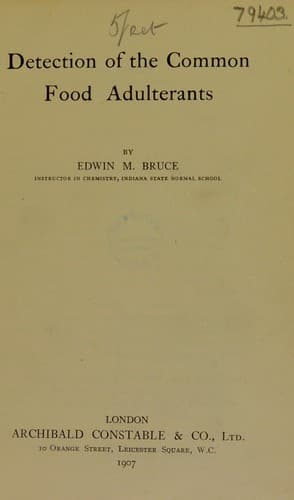
Detection of the Common Food AdulterantsBruce, Edwin M.
Science
Detection of the Common Food Adulterants
Bruce, Edwin M.
Food adulteration and inspection
_Kleeburg recommends the following test._--A little of the flour is
mixed on a piece of common window glass or microscope slide, with
sufficient water (at 45° C.) to float the flour particles. Spread the
mixture out over the glass, and press another glass down upon it. When
wheat flour is present, white spots will be seen, and if the glasses are
slid upon each other the spots will pull out into threads, and the
thicker and longer they are the more wheat flour there is present.
ERGOT IN RYE FLOUR
_Boettger gives the following chemical test for ergot._--Heat 10 to 15
minutes with an equal quantity of ether, adding a few crystals of oxalic
acid. When ergot is present a reddish color develops.
_Another Method._--Bul. 51, Bureau of Chem.
Digest 20 grams of the suspected flour, with boiling alcohol, till no
more color is extracted. Add 1 cc. of sulfuric acid (1 : 3), and if
ergot is present the solution will be colored red.
BREAD
ALUM
Moisten a piece of the bread with water, and then with a logwood
solution (5 grams logwood digested in 100 cc. of alcohol). If alum is
present the bread will become lavender blue in two or three hours. Pure
bread would have a red-brown tint. To prove the presence of alum, the
blue color must be permanent at the temperature of boiling water. (The
logwood used in this test must be pure.)
_Blyth’s Test._--Macerate 150 grams of the sample for 45 or 50 hours in
a couple liters of water; after straining through muslin, evaporate to a
small volume over a low flame. Immerse a strip of gelatin in this
liquid, and then in a logwood solution (same as in last test), and if
alum is present it will acquire the lavender color.
If the bread in either of these tests is sour, the following
modification (Vanderplanken) must be made. Reduce 15 grams of the sample
to a paste with water and some pure chlorid of sodium, adding 10 drops
of a fresh alcoholic solution of logwood, after which add 5 grams of
pure potassium carbonate. Mix well, and after washing with 100 cc. of
water into a vessel allow to settle. If alum is present the liquid will
soon become reddish-violet, and if not present it will be blue.
COPPER SULFATE
SEE TEST FOR COPPER SULFATE IN FLOUR
GINGER CAKE
Tin may be detected by the method for heavy metals under meat.
CHAPTER IV
LEAVENING MATERIALS
BAKING POWDERS
Baking powders consist of bicarbonate of soda and an acidifying agent as
acid potassium tartrate, acid calcium phosphate, tartaric acid or alum.
Some powders contain both acid calcium phosphate and alum. The kind of
powder is determined by testing for these. Gypsum has been added to
baking powders to increase the weight.
TARTARIC ACID
FREE OR COMBINED
Public-domain text, read in full here on John Shaqi.
Reviews
Reviews
No reviews yet
Be the first to share your thoughts on this work.
Join the Discussion
Join the discussion
Sign in to leave a comment or review.
Sign InorCreate an account