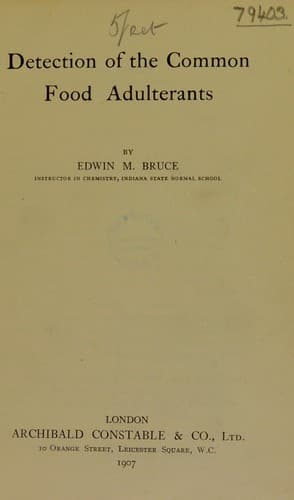
Detection of the Common Food AdulterantsBruce, Edwin M.
Science
Detection of the Common Food Adulterants
Bruce, Edwin M.
Food adulteration and inspection
Take up a part of the residue with water and taste. If it is very sweet
saccharin is present. Confirm by the following:
_Schmidt’s Test._--Add about 1 gram of sodium hydroxide to another part
of the residue, and heat in an air-oven or oil bath, for half an hour at
about 250° C., to convert the saccharin into salicylic acid. After it
has cooled, acidify with sulfuric acid, extract and test for salicylic
acid with 2 or 3 drops of ferric chlorid solution, letting the solutions
come together slowly. A purple or violet coloration proves the presence
of salicylic acid, which in turn indicates the presence of saccharin.
This test cannot be used if salicylic acid was used as a preservative in
the original product. A test for the acid should first be made.
_Bornstein’s Test._--Heat the remainder of the above ether residue with
resorcin and a very little sulfuric acid till it begins to swell. (It is
best to do this heating in a test-tube.) Let cool till the action stops,
heat again and repeat the operation several times. After cooling the
last time, dilute with water and add sodium hydrate till neutral. If
saccharin is present, there will be a red-green fluorescence.
BENZOIC ACID
Acidify 50 cc. of the sample with sulfuric acid and shake vigorously
with 50 cc. of a mixture of equal parts of ether and petroleum spirit.
Let the liquids separate, then draw off as much as possible of the
solvent and filter. (Use a centrifugal machine if an emulsion forms.)
Separate the extract into 2 parts and evaporate each to dryness over a
small flame and make the following tests:
_Ferric Chlorid Test._--Dissolve one of these residues in ammonia, and
evaporate to dryness on a water-bath. Take up the residue with warm
water, filter, and collect the filtrate in a small test tube. Add a drop
of ferric chlorid solution, and if benzoic acid is present a
characteristic flesh or brownish colored precipitate of ferric benzoate
forms. Sometimes in such products as sweet pickles, a basic ferric
acetate precipitate comes down and the following test had better be
applied.
_Peter’s Method._--Take about 0.1 gram of the second part of the above
ether residue, place in a large test tube (about 50 cc.) and dissolve in
5 to 8 cc. of concentrated sulfuric acid. Add from 0.5 to 0.8 gram of
barium peroxide, a little at a time. Shake each time and cool in water
if necessary. This should produce a permanent froth on the sulfuric
acid. Let stand 25 or 30 minutes, then fill the tube three fourths full
of water, shake and cool rapidly to the temperature of the room, and
filter off the barium sulfate. Extract with chloroform or ether. Remove
the extract and test it for salicylic acid with dilute ferric chlorid.
(See first test under salicylic acid.) In this method salicylic acid
must first be proven absent.
Public-domain text, read in full here on John Shaqi.
Reviews
Reviews
No reviews yet
Be the first to share your thoughts on this work.
Join the Discussion
Join the discussion
Sign in to leave a comment or review.
Sign InorCreate an account