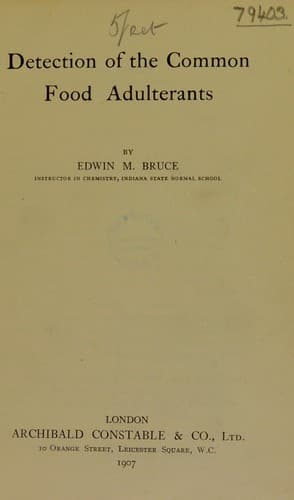
Detection of the Common Food AdulterantsBruce, Edwin M.
Science
Detection of the Common Food Adulterants
Bruce, Edwin M.
Food adulteration and inspection
_Sostegni and Carpentieri Test._--Such a test may be made by dissolving
15 grams of the fruit product in 100 cc. of water, filtering and
acidifying with a small quantity of a 10 per cent solution of
hydrochloric acid and again filtering. Place in the filtrate strips of
white woolen cloth (nun’s veiling will do) which have been freed from
grease by boiling first in very dilute caustic soda solution, then in
water, and boil for 5 to 10 minutes. Remove the cloth and wash it in
water, then boil in very dilute hydrochloric acid. Stir the cloth in
water to remove the acid and dissolve the color by boiling in a solution
of ammonium hydroxid (1 to 50). The time required will depend upon the
particular dye used. Remove the cloth from the solution and acidify the
latter with hydrochloric acid, a slight excess is better, and another
piece of the cleansed cloth is immersed and again boiled. Nothing but
coal-tar dyes will color in this second dyeing.
COCHINEAL
_Girard and Dupre Test._--See tests for cochineal under “Catsups and
tomatoes.”
ACID MAGENTA
_Girard and Dupre._--Make about 100 cc. solution of the fruit, filter,
and neutralize with potassium hydroxid (strength 5 to 100); about 2 cc.
will be needed. Add 4 cc. of mercuric acetate solution (1 to 10), shake
and filter. By this treatment the filtrate should be colorless and
slightly alkaline. Add sulfuric acid till there is a slight excess. A
colorless solution indicates the absence of acid magenta, while a light
violet-red shows its presence, providing the amyl-alcohol extract showed
no other dye to be present.
CARAMEL
_Amthor’s Test._--10 cc. of a solution of the fruit is put into a deep,
narrow glass (a bottle may be used). Add 30 to 50 cc. of paraldehyde, to
be gaged by the intensity of the coloring. Then add a sufficient
quantity of absolute alcohol to make the solutions mix. If caramel is
present, a brownish-yellow to dark-brown precipitate will be formed,
decant, wash the precipitate once with absolute alcohol, dissolve in a
little hot water and filter. The shade of color is proportional to the
amount of caramel present.
To verify the test, pour the colored fluid into a freshly prepared
solution of phenylhydrazin (2 parts phenylhydrazin-hydrochlorid, 3 parts
sodium acetate, and 20 parts water). Much caramel produces a dark-brown
precipitate in the cold, and is hastened by slightly heating. A very
small amount of caramel will require several hours to precipitate.
APPLE-JUICE IN JELLIES MADE OF SMALL FRUITS
Very often cider is added to other fruit juices to give them the proper
consistency in jellies, jams, and marmalades.
Public-domain text, read in full here on John Shaqi.
Reviews
Reviews
No reviews yet
Be the first to share your thoughts on this work.
Join the Discussion
Join the discussion
Sign in to leave a comment or review.
Sign InorCreate an account