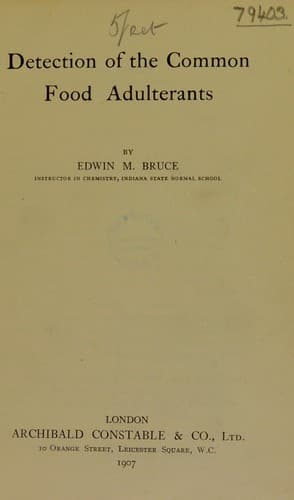
Detection of the Common Food AdulterantsBruce, Edwin M.
Science
Detection of the Common Food Adulterants
Bruce, Edwin M.
Food adulteration and inspection
Its presence may some times be determined by making the usual starch
test. A large quantity of starch is normally present in apples, but is
less as they ripen, and finally disappears in the ripened fruit. There
is no starch, or only a mere trace, in small fruits even when green. It
is readily seen that if the juice is taken from green apples that there
will be starch found in the artificial jelly or jam, though its absence
does not prove the absence of cider.
Make the starch test as follows:
STARCH
IN JELLIES, JAMS, AND SUCH PRODUCTS
Make a solution of the jelly or jam and destroy the color by heating
nearly to the boiling point and adding dilute (1 : 3) sulfuric acid and
potassium permanganate until the color is destroyed. This treatment does
not affect the starch, and when cool add iodin, preferably potassium
iodid-iodin (potassium iodid, 0.4 gram; iodin, 0.1 gram; water, 20 cc.).
If a great quantity of starch is present an almost black precipitate
will be formed. Smaller amounts give the usual blue color.
Whenever starch is found to be present, it is best to make a
microscopical examination in the case of jams and marmalades. If the
starch is normally present the grains will be seen within the cell walls
after the iodin treatment.
Starch is nearly always present in the apple and some other fruits, so
unless it is present in jelly and such products in considerable quantity
it is not likely that it was added.
GELATIN
IN JELLIES
_Henzold Test._--Add water to some of the jelly and boil for a short
time, filter and treat the filtrate with an excess of a 10 per cent
solution of potassium bichromate and boil again. After cooling add 2 or
3 drops of concentrated sulfuric acid. A white flocculent precipitate
forms if gelatin is present, and it gradually collects in a lump at the
bottom.
_E. Beckmann’s Method._--Treat the jelly with 95 per cent alcohol and
wash the precipitate with alcohol to free it from the sugar, then drive
off the alcohol by heating. Add a very little water to the residue and
neutralize the extract with calcium carbonate. Then add formalin and
evaporate to dryness. By this treatment gelatin is rendered insoluble.
Pure fruit jellies have only 1 to 2 per cent of insoluble precipitate,
while those jellies in which gelatin is used have 70 to 86 per cent of
insoluble precipitate.
AGAR AGAR
Boil the sample with 5 per cent sulfuric acid. Add a crystal or two of
potassium permanganate, and wait till it settles, and examine the
sediment for diatoms with a microscope. Their presence shows the use of
agar.
HEAVY METALS
TIN, ZINC, LEAD, AND COPPER
_A. H. Allen’s Method._--(See test for heavy metals under canned meat.)
ARSENIC
Public-domain text, read in full here on John Shaqi.
Reviews
Reviews
No reviews yet
Be the first to share your thoughts on this work.
Join the Discussion
Join the discussion
Sign in to leave a comment or review.
Sign InorCreate an account