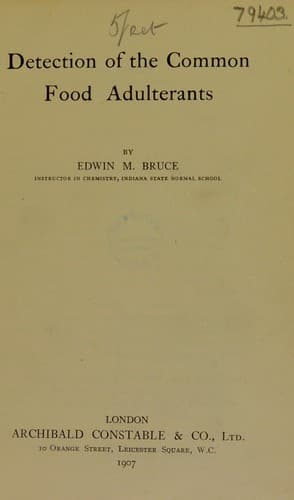
Detection of the Common Food AdulterantsBruce, Edwin M.
Science
Detection of the Common Food Adulterants
Bruce, Edwin M.
Food adulteration and inspection
In case the sample is too much of a solid to get the arsenic out by the
above treatment, it may be prepared according to the directions of
Chittenden and Donaldson: Heat 100 grams of the macerated sample with 23
cc. of pure, strong nitric acid to a temperature of 150° C. or 160° C.
Assist the action by stirring occasionally. When the fruit becomes a
deep yellow or orange color, remove the heat and add 3 cc. of pure,
strong sulfuric acid. It should be stirred while nitrous fumes are
passing off. Heat again to about 180° C., and before it cools add, drop
by drop, 8 cc. of pure concentrated nitric acid. It should be stirred
constantly while the acid is being added. Heat at 200° C. till sulfuric
acid fumes begin to come off and only a dry mass remains. Powder the
mass and exhaust it with boiling water, filter and test the solution
when cold with Marsh’s test.
CHAPTER VII
FLAVORING EXTRACTS
LEMON EXTRACT
The important ingredients of lemon extract are lemon oil and citral, its
aromatic constituent. Oil of citronella and oil of lemon grass are
sometimes substituted for lemon oil. Methyl alcohol is sometimes used in
place of the more expensive spirit alcohol as a solvent for the lemon
oil.
LEMON OIL
The presence of lemon oil may be detected by adding a large excess of
water to a small amount of the extract in a test tube. If the mixture
does not show some cloudiness, it is a strong indication that no lemon
oil is present. The degree of cloudiness gives an idea of the amount of
oil present.
CITRAL
This is present in the oil of lemon grass, which is sometimes used as a
substitute for lemon oil. Citral may be detected by the following test
by Burgess:
Add 20 cc. of sulfuric acid to 85 cc. of water. Dissolve in this mixture
10 grams of mercuric sulfate. Shake 2 cc. of the sample with 5 cc. of
this reagent in a test tube. If citral is present, the liquid will be
bright red, and will quickly disappear and give place to a whitish
compound, which floats on top.
OIL OF CITRONELLA
This is often substituted for lemon oil. It may be detected by the same
test which was used for citral. Instead of the red color and the white
compound, citronella gives a bright yellow color, which does not
disappear for some time.
TARTARIC OR CITRIC ACID
Precipitate the oil by the addition of an equal volume of water. Filter
and add a very little of the filtrate to a test tube nearly full of cold
lime water. A precipitate will form if tartaric acid is present and it
will dissolve in an excess of ammonium chlorid or acetic acid. Filter,
or, in case no precipitate forms, heat the liquid. Citric acid is
precipitated in the presence of a large excess of hot lime water.
METHYL ALCOHOL
Public-domain text, read in full here on John Shaqi.
Reviews
Reviews
No reviews yet
Be the first to share your thoughts on this work.
Join the Discussion
Join the discussion
Sign in to leave a comment or review.
Sign InorCreate an account