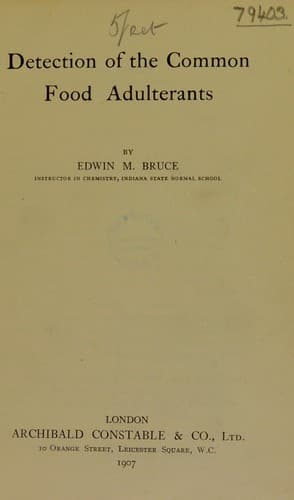
Detection of the Common Food AdulterantsBruce, Edwin M.
Science
Detection of the Common Food Adulterants
Bruce, Edwin M.
Food adulteration and inspection
Evaporate 200 to 400 cc. of the vinegar to dryness, add a little sodium
hydroxid to this residue and burn to an ash over a low flame. It may be
necessary to add a little potassium nitrate once or twice. Add a little
dilute hydrochloric acid and saturate with hydrogen sulfid and test for
lead, zinc, copper, and arsenic according to Allen’s method given under
canned meats.
SPICES TO INCREASE PUNGENCY
_Leach._--Neutralize a portion of the vinegar with sodium carbonate. The
presence of spices is easily detected by tasting this mixture.
_Another Test._--Exactly neutralize a little of the vinegar as above,
evaporate to smaller bulk and taste as before, then shake the
concentrated liquid with ether, separate the ethereal layer and
evaporate it, and taste the residue.
TARTAR IN WINE VINEGAR
The presence of tartar in vinegar proves it to be wine vinegar.
_Allen’s Method._--Evaporate a portion of the vinegar and treat the
residue with alcohol; a granular residue of tartar remains undissolved.
To prove that it is tartar, decant the alcohol and dissolve the residue
in a little hot water, cool, rub the inside of the vessel with a glass
rod, and if tartar was present acid potassium tartrate will be deposited
where the rod touched the vessel. The test will be more sensitive if an
equal volume of alcohol is added.
FREE TARTARIC ACID IN WINE VINEGAR
_Test as for Tartar._--Treat the alcoholic solution of the extract with
an alcoholic solution of potassium acetate. Rub the sides of the vessel
as before, and if tartaric acid is present the streaks and sometimes a
precipitate forms where the rod touches the vessel.
GLUCOSE
Glucose is present when both direct and invert readings are
dextro-rotatory.
CHAPTER XI
FATS AND OILS
LARD
Lard is very often adulterated with cottonseed oil, cottonseed stearin
and beef stearin. Their being very much cheaper accounts for the
sophistication.
COTTONSEED OIL
_Halphen’s Test._--Dissolve 1 per cent of sulfur in a given volume of
carbon bisulfid. Add an equal volume of amylic alcohol. Mix 3 to 5 cc.
of this reagent with an equal volume of the melted lard in a test tube.
Close with a cotton stopper and boil for 15 minutes in a bath of
saturated brine. The presence of cottonseed oil is indicated by a
deep-red or orange color, little or no color resulting in its absence.
Lard from hogs fed on any of the various cottonseed products may give a
faint reaction when this test is applied.
COTTONSEED STEARIN
Since cottonseed stearin is only the more solid portions of cottonseed
oil, the above test may be applied, but to distinguish it from the
latter it is necessary to make determinations quite beyond the scope of
this set of tests.
BEEF-STEARIN
Public-domain text, read in full here on John Shaqi.
Reviews
Reviews
No reviews yet
Be the first to share your thoughts on this work.
Join the Discussion
Join the discussion
Sign in to leave a comment or review.
Sign InorCreate an account