Development of Muslim Theology, Jurisprudence, and Constitutional Theory — John Shaqi
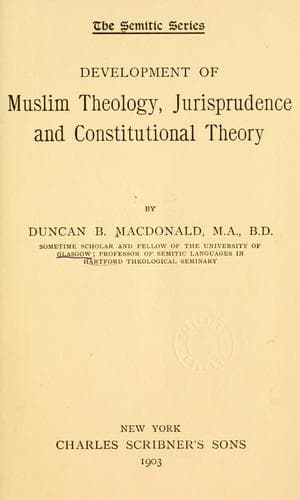
Development of Muslim Theology, Jurisprudence, and Constitutional TheoryMacDonald, Duncan Black
ReligionIslamic
Development of Muslim Theology, Jurisprudence, and Constitutional Theory
MacDonald, Duncan Black
Constitutional law (Islamic law); Islam -- Doctrines -- History; Islam and state -- History; Islamic law -- History
To return: in this first elective council the choice fell upon Abu
Bakr. He was a man distinguished by his piety and his affection for and
close intimacy with Muhammad. He was the father of Muhammad’s favorite
wife, A’isha, and was some two years younger than his son-in-law. He
was, also, one of the earliest believers and it is evident that this,
with his advanced age, always respected in Arabia, went far to secure
his election. Yet his election did not pass off without a struggle in
which the elements that later came to absolute schism and revolution
are plainly visible. The scene, as it can be put together from Arabic
historians, is curiously suggestive of the methods of modern politics. As
soon as it was assured that the Prophet, the hand which had held together
all those clashing interests, was really dead, a convention was called
of the leaders of the people. There the strife ran so high between the
Ansar, the Muhajirs and the Muslim aristocrats of the house of Umayya,
that they almost came to blows. Suddenly in the tumult, Umar, a man of
character and decision, “rushed the convention” by solemnly giving to Abu
Bakr the hand-grasp of fealty. The accomplished fact was recognized—as
it has always been in Islam—and on the next day the general mass of the
people swore allegiance to the first Khalifa, literally Successor, of
Muhammad.
On his death, in A.H. 13 (A.D. 634), there followed Umar. His election
passed off quietly. He had been nominated by Abu Bakr and nothing
remained but for the people to confirm that nomination. There thus
entered a second principle—or rather precedent—beside that of simple
election. A certain right was recognized in the Khalifa to nominate his
successor, provided he chose one suitable and eligible in other respects.
Unlike Cromwell in a similar case, Abu Bakr did not nominate one of his
own sons, but the man who had been his right hand and who, he knew, could
best build up the state. His foresight was proved by the event, and Umar
proved the second founder of Islam by his genius as a ruler and organizer
and his self-devotion as a man. Through his generals, Damascus and
Jerusalem were taken, Persia crushed in the great battles of al-Qadisiya
and Nahawand, and Egypt conquered. He was also the organizer of the
Muslim state, and it will be advisable to describe part of his system,
both for its own sake and in order to point the contrast with that of
his successors. He saw clearly what were the conditions under which the
Muslims must work, and devised a plan, evidently based on Persian methods
of government, which, for the time at least, was perfect in its way.
[Sidenote: CONSTITUTION OF UMAR]
Public-domain text, read in full here on John Shaqi.
Reviews
Reviews
No reviews yet
Be the first to share your thoughts on this work.
Join the Discussion
Join the discussion
Sign in to leave a comment or review.
Sign InorCreate an account