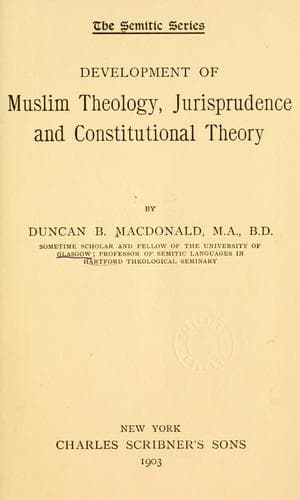
Development of Muslim Theology, Jurisprudence, and Constitutional Theory — John Shaqi
Development of Muslim Theology, Jurisprudence, and Constitutional TheoryMacDonald, Duncan Black
ReligionIslamic
Development of Muslim Theology, Jurisprudence, and Constitutional Theory
MacDonald, Duncan Black
Constitutional law (Islamic law); Islam -- Doctrines -- History; Islam and state -- History; Islamic law -- History
The elements in the problem were simple. There was the flood of Arabs
pouring out of Arabia and bearing everything down in their course.
These must be retained as a conquering instrument if Islam were to
exist. Thus they must be prevented from settling down on the rich lands
they had seized,—from becoming agriculturists, merchants, and so on,
and so losing their identity among other peoples. The whole Arab stock
must be preserved as a warrior caste to fight the battles of God.
This was secured by a regulation that no new lands should be held by a
Muslim. When a country was conquered, the land was left to its previous
possessors with the duty of paying a high rent to the Muslim state
and, besides, of furnishing fodder and food, clothing and everything
necessary to the Muslim camp that guarded them. These camps, or rather
camp-cities, were scattered over the conquered countries and were
practically settlements of Muslims _in partibus infidelium_. The duty
of these Muslims was to be soldiers only. They were fed and clothed by
the state, and the money paid into the public treasury, consisting of
plunder or rents of conquered lands (_kharaj_), or the head-tax on all
non-Muslims (_jizya_), was regularly divided among them and the other
believers. If a non-Muslim embraced Islam, then he no longer paid the
head-tax, but the land which he had previously held was divided among his
former co-religionists, and they became responsible to the state. He,
on the other hand, received his share of the public moneys as regularly
distributed. Within Arabia itself, no non-Muslim was permitted to live.
It was preserved, if we may use the expression, as a breeding-ground
for defenders of the faith and as a sacred soil not to be polluted by
the foot of an unbeliever. It will readily be seen what the results of
such a system must have been. The entire Muslim people was retained as
a gigantic fighting machine, and the conquered peoples were machines
again to furnish it with what was needed. The system was communistic, but
in favor of one special caste. The others—the conquered peoples—were
crushed to the ground beneath their burdens. Yet they could not sell
their land and leave the country; there was no one to buy it. The Muslims
would not, and their fellow-co-religionists could not, for with it went
the land-tax.
[Sidenote: UTHMAN]
Public-domain text, read in full here on John Shaqi.
Reviews
Reviews
No reviews yet
Be the first to share your thoughts on this work.
Join the Discussion
Join the discussion
Sign in to leave a comment or review.
Sign InorCreate an account